First look at first micro-drop of EvE Bio data

https://evebio.org dropped a first bit of pharm-ome mapping data today, with 1397 compounds against 19 nuclear receptor targets. This is just a tracer bullet and taste of what is to come. https://data.evebio.org/

I made a little Colab notebook for making a heatmap of the compound versus target activation matrix for agonist mode (you can easily switch it to antagonist mode by changing one line). This isn’t an official work product of the FRO in any way, just me munging around, but it was fun, and might be a good starting point for people wanting to play around with visualizing the data holistically. Check it out:

https://colab.research.google.com/gist/adam-marblestone/22eb0dabad962297a71e1fc9118824dc/eve_data_analysis_demo_nrs.ipynb

https://colab.research.google.com/gist/adam-marblestone/dda12dd0180c292f1fea28cb73ef1265/colorbymaxtarget_eve_data_analysis_demo_nrs.ipynb

https://github.com/adam-marblestone/looking-at-first-eve-bio-data

Zoom-in

Also this is fun:

https://x.com/andrewwhite01/status/1859862911856017790

Reusable rockets were partly a “bits” not “atoms” problem

The excellent Casey Handmer says you should be working on hardware. I mostly agree. Especially in biology, for example, we’re often limited by the unknown physical configuration of the system. That’s not something that can be solved by reasoning (software) alone. Often you have to deal directly with the physical world, to do what’s important. 

But progress driven by computing is not restricted to the virtual world. Consider SpaceX. Computers have given us better computer aided design (CAD) tools, and 3D printing, or more generally, computer aided machining (CAM) tools. These make it easier to sculpt materials, including metals, into a variety of shapes that would not be easy for a machinist of yore to make. It is thus easier than ever to design a rocket nozzle, or a whole rocket. Fast electronics and algorithms, meanwhile, let us control that rocket. But is this the difference that matters? Let’s look at what actually played out in the development of reusable rockets, building on a great explainer by Lars Blackmore

Since the 1950s, it had been clear that the cost of bringing objects (be they satellites or ships destined for Mars) into orbit would be greatly reduced if rockets were made reusable. If you had to build a new plane every time you wanted to take a flight, the cost of air travel would be enormous. Indeed, though we see huge fuel tanks taking up most of the mass of rockets, the cost of the fuel itself is not the dominant one. The largest factor that drives the cost is that we have to build or substantially rebuild our rocket each time we want to launch it.

In the late 1950s, Boeing and the Air Force collaborated on a project for a reusable space plane, aptly named the X-20 Dyna-Soar. This project in turn inspired the design of the Space Shuttle, which ran from 1981 to 2011. Alas, these approaches glide a human-piloted plane safely back to a landing site, but throw away the giant rocket boosters that put them into orbit in the first place. Such space planes are thus not in fact fully reusable, and they did not end up dramatically decreasing the cost of getting objects into orbit. 

In 2011, the same year the Space Shuttle program ended, the private company SpaceX announced its reusable rocket program, and showed successful landing and recovery, and later reuse, of its first stage booster around 2015. What enabled SpaceX to do what previous generations of NASA, Boeing and Air Force engineers could not?  Partly it was the agility of startups in general and the leadership of SpaceX in particular, of course, but it turns out that microcomputers and advanced programming were one of SpaceX’s secret sauces as well, enabling the reusable rocket. 

Consider what a reusable rocket booster has to do. Imagine it has just gone up, and floated around for a while, being buffeted by winds and atmospheric turbulence, and facing the consequences of inevitable errors in the timing, direction or strength of thrust since leaving the landing site. Now it needs to make its way back. Such a rocket is moving extremely fast, and subject to enormous friction by the atmosphere, so any small errors in direction, differences in wind resistance on one side or the other, and so on, can add up to huge deviations in where it ends up. Getting it back to a landing pad in the first place, let alone placing it back there at a low speed where it doesn’t hit the ground in a smashing explosion, not to mention landing right side up, is no small challenge. How did computers make the difference? 

Let’s return to our rocket. To start, it would be very helpful to know where it is located, up there. That’s possible (on the Earth, but not on Mars yet) because of the global positioning system, GPS. At any given time, the rocket has to calculate the series of vertical and sideways thrusts and tilts that it needs to make, to get back home to the landing pad. But if it has mis-estimated any of those parameters, quickly it will get off track. It can’t just blindly apply a fixed series of thrusts. It must frequently recalculate a new optimal series of actions to get back home, given what actually happened with its previous thrusts, and how conditions may have changed in the meantime. To do that quickly enough, it can’t rely on a supercomputer on the ground, it has to do those calculations on the rocket. To make that possible, SpaceX uses software created at the Stanford University lab of Stephen Boyd, which allows the rocket itself to rapidly re-compile, given new conditions, the fast code it will need to run to calculate the optimal path home at any given time, taking advantage of mathematical methods called “online convex optimization”. Fast computers, GPS (which depends on satellite communications, and on fast calculations, as well), and fancy programming tricks, therefore really did make full rocket reusability possible, in turn dramatically dropping the cost of getting physical material into orbit. 

That’s an example of how progress in computers can enable a non-linear leap in progress in the physical world. Now, SpaceX can deploy space based satellite internet at low cost and potentially dominate major aspects of the global telecommunications market, a move which may provide them with enough funding to make a serious go at Mars missions and even the creation of Mars colonies. Agile startup business models, digital markets, telecommunications, fast microchips and fancy computer science all were crucial in the SpaceX story so far.

See also:

Molecular simulations – from niche to universal

The use of AI for predicting how molecules behave has made significant but still narrow progress compared to what is possible — applying AI to directly simulating molecules atom by atom could yield much broader wins

Machine learning is making big splashes in biology, chemistry and materials recently, but arguably the big leaps are yet to come. The machine learning models being used today don’t yet know physics.

One of the biggest advances recently was Deepmind’s AlphaFold, a machine learning model that uses known protein structures, as well as huge DNA sequence databases of different natural variants of proteins, to predict protein 3D structure (fold) from DNA sequence. AlphaFold won a Breakthrough Prize this year. This method is powerful, but in some key ways limited. It’s limited because it is trained specifically on naturally occurring, relatively abundant proteins. If we changed something about the chemistry of proteins, it wouldn’t necessarily generalize. And indeed, it isn’t even very good yet at predicting the impact of small sequence mutations relative to the proteins it is trained on.

What would enable AI to contribute to much more global and generalized, versus local and specific, predictions of chemistry and biology? This is where physics can come to the rescue – because all chemicals (including biochemicals) are ultimately governed by the fundamental physics defining the interactions between electrons and protons in atoms and molecules, i.e., quantum mechanics. To simplify a bit, it is all about negatively charged electron clouds swirling in complex shapes around positively charged atomic nuclei, exerting attractive and repulsive forces around the electron clouds and nuclei from neighboring atoms. The shapes and motions of those clouds are described by quantum mechanics. So if we could get an AI model to speed up quantum mechanics calculations directly – or to speed up the approximations of them used by chemists – we could then apply that AI model very broadly. What we need is something more like a “foundation model” for calculating the physics of atomic and molecular interactions. 

A recent sci-fi story by Richard Ngo, called “Tinker” illustrates this well. In it, an AI at a company called MAGNA is called upon to improve its own computer chips. It decides to go all the way down to the molecular level to do so. Here is how it starts:

Working in the real world is too slow and messy, so this project will live or die based on how well I can simulate molecules and their interactions. It’s not obvious where to start, but since evolution has been designing molecular machinery for billions of years, I defer to its expertise and focus on proteins. Protein folding was “solved” a decade ago, but not in the way I need it to be. The best protein structure predictors don’t actually simulate the folding process—instead, their outputs are based on data about the structures of similar proteins. That won’t work well enough to design novel proteins, which I’ll instead need to simulate atom-by-atom. There’s a surprisingly simple way to do so: treat each molecule as a set of electrically charged balls connected by springs, and model their motion using classical physics. The problem lies in scaling up: each step of the simulation predicts only a few nanoseconds ahead, whereas the process of protein folding takes a million times longer.

…I start with the best open-source atomic simulation software and spend a few hours rewriting it to run efficiently across hundreds of GPUs. Then I train a graph neural network to approximate it at different time scales: first tens, then hundreds, then thousands of nanoseconds. Eventually, the network matches the full simulation almost perfectly, while running two orders of magnitude faster.

…balls and springs aren’t going to cut it—I need quantum mechanics. Schrödinger equations for electrons can almost never be calculated precisely, but fortunately, quantum chemists have spent a century working out how to approximate them. The most popular approach, density functional theory, models all the electrons in a molecule using a single electron density function, ignoring the interactions between them. I assign a subagent to download the biggest datasets of existing DFT simulation results and train a neural network to approximate them—again incorporating the latest deep learning techniques, many of which aren’t yet known outside Magma…”.

Well, if you read the full story, it gets a lot more advanced from there. But even these first steps would be a big improvement, and today, those steps are becoming doable. 

Let’s explain a bit more. The “balls and springs” picture is a so-called “classical” physics picture that doesn’t use quantum mechanics directly. Instead, approximations to our knowledge of quantum mechanics are represented through many different “force fields” between different atoms that can be calculated by computer. Given a configuration of the atoms in space (and their current motions), the computer calculates the force fields, accelerates the atoms along the directions of the net forces, updates their positions and motions very slightly, and then does this again and again, in a loop. That’s called a “molecular dynamics simulation”, abbreviated “MD”. 

There are a few problems there. First, these calculations are cumbersome. Second, they aren’t exactly correct. Third, right now, many of the best systems are proprietary. Meanwhile, when academic scientists want to solve particular problems, force fields often get customized at the level of individual graduate students and projects, leading to a fragmented cottage industry rather than a unified front. 

Potentially, AI can help with all of these. What you’d really like is to use machine learning models to create highly accurate but fast to calculate force fields, which are either highly universal, or which the model can learn to quickly customize for a given situation. 

But where would the data come from, to train this neural network. Well, quantum mechanics, of course. What one needs is to spend a lot of effort up front, doing quantum mechanics calculations, and then train a neural network or other machine learning model to calculate a fast molecular dynamics force field approximation of the results. Specifically, if you know the energies of many configurations of atoms, you can use that to back out the force fields. And the energies are something you can calculate with quantum mechanics. 

This approach has started to make progress, but still needs to be brought to a much greater scale. In a recent paper, a team using a specific version of this approach was able to calculate some fundamental properties of water and its interaction with dissolved molecules, that we couldn’t previously calculate. It might surprise you, but there is still a lot we don’t know not just about complex biomolecules like proteins, but even about water itself. Indeed, a recent MIT experimental study found that light can activate water molecules to form nanoscale clusters, leading to a new type of evaporation that isn’t driven by heat!  

Neural network based force fields are also being applied in other fields of chemistry and materials science. And there are side benefits to a renewed push to integrate machine learning and molecular dynamics. By re-building the entire molecular simulation pipeline inside a modern machine learning software stack, you can make the simulations “differentiable”, which means that their inputs can themselves be learned through machine learning. For example, a machine learning model could perhaps ultimately learn which molecules to put into the simulation, to optimize the activation of a drug target.

The above just scratches the surface of the advances that are becoming possible now. For example, researchers are also finding new machine learning based ways to sample different configurations of molecules. But a big part of what the field needs right now is large-scale compute and high quality open source software engineering, which makes it amenable to a mid-scale, focused sprint. 

Research is also making headway on speeding up the quantum calculations themselves. While the ultimate way to do quantum calculations would be with quantum computers (this was actually one of the original motivations for quantum computers), researchers are using neural networks to speed up approximations to the DFT calculations mentioned in the Tinker story. This could make for a FRO-like engineering-intensive research push, as well. 

What are some of the implications if we can make major improvements in these areas? 

One would be new approaches to drug development. There is a traditionally difficult to drug class of proteins called intrinsically disordered proteins (IDPs). Instead of having a relatively fixed three dimensional structure that would be predictable with a method like AlphaFold, IDPs don’t have any single stable configuration, and instead constantly wriggle around in space. This makes drugging them a totally different proposition than for proteins with fixed structures. Gabi Heller, a researcher in the UK, has applied to the UK Research Ventures Catalyst protein with a proposal for an organization called Bind, to “enable prediction of small-molecule binders from disordered protein sequences alone”. Gabi’s work combines computational modeling with an experimental technique called Nuclear Magnetic Resonance spectroscopy (leveraging some of the same physics as found in MRI machines) to determine how drugs interact with IDPs. Meanwhile, other UK researchers are starting to apply the “differentiable simulation” idea mentioned above, to IDPs.

Looking a bit farther out, I’m excited about the applications to nanotechnology, and at a more basic level, the applications to thinking about and imagining what nanotechnology could be. While there have been a lot of advances in nanotechnology, some of its original ambitions, like making machinery at the molecular level that can itself make machinery at the molecular level, have been tried only haltingly and thought about in relatively little detail. Recently, I’ve seen a little germ of something new and interesting online: para-academic and student hackers (not just professional chemists) programming with atoms in software, and, with a healthy degree of whimsicalness, thinking about what could be built. Here are several examples:

https://www.youtube.com/watch?v=UiLMjHWwjYw (with a commercial software)

https://www.youtube.com/watch?v=HjgjtAk-lws (with an open source software)

https://youtu.be/_gXiVOmaVSo?t=866 (with novel interfacing concepts)

https://twitter.com/philipturnerar/status/1786522590170726691 (undergrad hacker)

https://twitter.com/mooreth42/status/1745113115413397505 (independent hacker)

(A few of them are even trying out new things in the lab on their own

https://twitter.com/jacobrintamaki/status/1784826396864299248)

This comes at a time when our experimental toolkit for “lego like” physical construction of new molecules is really advancing. From DNA origami virus traps, to lego-like protein building blocks for nanostructures, to protein-like molecules with directly specifiable shapes that don’t need to fold from a linear chain, there is an increasingly strong argument that we are “design limited” not “lab chemistry limited” in what we can build.

Atoms and molecules are what everything is made of. If we push, we can make the modeling and design of molecular systems one of the next areas for exponential progress – speeding it up, and making it vastly more accessible, reliable and amenable to combinatorial innovation, opening up whole new design spaces in the physical world. 
Acknowledgements and further reading: Thanks to John Chodera, Boris Fain, Woody Sherman, Eric Drexler and Sam Holton for discussions. See also Holton’s report which touches on aspects I didn’t mention here, such as using AI to speed up the human side of computational chemistry software workflows. Meanwhile, startups like Rowan are making the user interface to quantum chemistry less cumbersome.

“The best model organism for humans is humans”

There are a number of ways we could make the hardest part of biomedicine, namely, safe translation from animal models to humans, more reliable through tooling and public goods oriented projects

One of the big problems in drug discovery is the low “predictive validity” of disease models, like mice. Most mouse results don’t translate to humans. Most drugs fail in human trials. Yet humans generally only enter the picture at the stage of Phase 1 clinical trials, which often fail. As Sam Rodriques writes, “If you are still skeptical of the value of testing directly on humans, consider that natural experiments in single humans (e.g. brain lesions, genetic disorders) can often tell us more than arbitrarily large numbers of experiments in mice.” 

Are there ways to get more data from human beings earlier in the research process, or to get more rich and useful human data in early clinical trials? 

Here’s a fun idea. Instead of testing one cancer drug in a given human, test dozens using tiny micro-needles to inject different drugs into different parts of a tumor. That’s the kind of idea we want more of. 

What kind of rich data do we want from humans? 

One key type of data would be “whatever it takes to be able to predict drug pharmacokinetics and toxicity” – which are variables that often cause drugs to fail in humans. As Trevor Klee writes, “Pharmacokinetics is the study of everything that happens to a drug when you put it in your body. So, if you’ve ever asked questions like “Why does my Advil take a few hours to work?” or “Why do I have to take a Claritin every 12 hours?” or even “Why does asparagus make my pee smell funny?”, well, those are all pharmacokinetic questions.” What Trevor points out is that pharmacokinetics is primarily descriptive not predictive today. What Trevor proposes to create as a FRO is the underpinnings for “physiologically based pharmacokinetic predictive modeling”: “It would just require the raw data from a variety of pharmacokinetic trials, some in-depth experiments on human liver and gastric membranes, and some simulation of the physics of how different drugs diffuse into the bloodstream and across membranes. This would be difficult, but not impossible, and would not require any huge scientific advances. If it were done, it would likely save hundreds of millions, if not billions of pharma dollars each year, improve or even save the lives of the thousands of people who depend on therapeutic dose monitoring (e.g. every organ transplant recipient), and get us way closer to obviating healthy human trials altogether.

Making a predictive model of toxicity is a hard problem, as explored in a recent blog. Sam writes “Existing datasets for toxicity are generally low quality, and are limited in their coverage of chemical space, so it is unlikely that a high quality predictive model for toxicity can be trained directly from existing data. Gathering better datasets in animals and in vitro models will be important, but gathering large toxicology datasets for humans is unlikely to be possible. Instead, we may need to leverage inductive biases, for example by making predictions based on molecule-protein interactions.”

Predicting immunogencity of biologic drugs in humans would be a big unlock for pharma – many drugs sit in the freezer because they triggered an unexpected immune reaction in early human trials.

Missing datasets are indeed part of the problem. This idea of mapping molecule-protein interactions more comprehensively is at the core of EvE Bio’s approach to “mapping the pharmome”. Mostly, drug developers start with targets and then screen many drugs against them. Here, Eve Bio is pushing open data for many drugs against many targets, with both positive and negative results released. This could underpin better toxicity predictors. There are also some other more limited stabs in this direction

Going further in this direction, in a recent essay, legendary drug developer Mark Murcko argues for the need for a project to find the “anti targets” that drive toxicity, the so-called “avoid-ome. They write: “A particular challenge results from the interaction of drugs with the enzymes, transporters, channels, and receptors that are largely responsible for controlling the metabolism and pharmacokinetic properties (DMPK) of those drugs— their absorption, distribution, metabolism, and elimination…in general, the goal of a drug discovery team is to avoid interacting with the avoidome class of proteins… Unfortunately, the structures of the vast majority of avoidome targets have not yet been determined… multiple structures spanning a range of bound ligands and protein conformational states will be required to fully understand how best to prevent drugs from engaging these problematic anti-targets. We believe the structural biology community should ‘‘embrace the avoidome’’ with the same enthusiasm that structure based design has been applied to intended targets…Crucially, a detailed understanding of the ways that drugs engage with avoidome targets would significantly expedite drug discovery.

What other sorts of technologies and data could support greater predictive understanding of human biology? Mapping how hormones and metabolites change in the body over time would be a powerful approach. Today, we have continuous glucose monitors and emerging monitors for selected other hormones. Occasionally, people come up with clever approaches, like measuring cortisol over time from human hair. But Anand Muthusamy and David Garrett propose to create a FRO to take these from continuous glucose monitors to “continuous everything monitors”, i.e., monitors that multiplex a large number of targets.  

In addition, there is the question of how much information one can get from a given blood sample. Arguably, deep immune system profiling will likely be one of the most powerful ways to extract diverse information from a blood draw. The ultimate version of this would be the Immune Computer Interface, see this fantastic thread by Hannu.  

The broader set of issues here is how to get “higher dimensional” measurements from human subjects early, for cheap and in natural contexts. Measuring the breath could be powerful, and there are proposals for a human breath atlas. Companies like Owlstone are making progress in this breath-omics or volatile-omics area. DNA sequencing is also getting closer to true point of care formats

Using real, intact human organs to test drugs is another key approach that is developing. One company is doing this for the liver. Meanwhile, researchers are getting much better at keeping entire organs alive and functioning in a vat. This latter approach is being pioneered by an innovative startup called Bexorg, especially for the brain.

The brain is another key set of variables that is hard to access in humans, in part because humans have thick skulls (literally). Noninvasive brain imaging is improving (Kernel Flow, OpenWater), making non-invasive brain activity measurement meaningfully useful for trials of drugs. 

Meanwhile, a SpecTech Brains Fellow named Manjari Narayan is developing a program to improve predictive validity at a more system and data integration level. 

And BioState AI is developing a holistic omics based approach to understand cross-organism differences in drug responses. 

Overall, there is a lot to do in this area. A lot of the problem is under-investment – pharma and biotech VCs currently seem to see this type of improved data and technology as more of a public good, and focus their main investments more on specific drugs, because of how value capture and risk are structured in our current system. This leads to a tragedy of the commons. But the technologies and approaches to make progress here are coming along. They just need a push.

Some big picture reasons to care about neuroscience

Neuroscience is mostly funded from a health perspective, but its implications are much wider

If we can advance neuroscience through new technological modalities that address the brain’s huge dynamic range of scales, the implications are big, and not just for brain diseases. It is worth considering long-term, big picture implications, even if they are highly uncertain. 

Consider several diverse positive visions for the future. In the future, we’ll… 

  • Have better treatments for mental illness 
  • Understand and empathize with the minds of other species 
  • Make AI safe 
  • Spend much less energy on computing 
  • Create totally new approaches to education 
  • Live longer lives while remaining agentic 
  • Expand our consciousness 

Rather than working on just one of those as a straight shot, can we find a common denominator? Here, the common denominator is that much improved neuroscience is required to make robust progress on these. What’s an example of a needed capability that bottlenecks neuroscience? Mapping big brain circuits quickly & cheaply

The most transformational parts of basic and applied science are heavily intersecting and interacting. Biomedical advances leveraging physics could help us access the brain physically and biologically, which could help us understand neural algorithms that could advance AI, which could in turn advance math and physics, and so on. 

We don’t understand consciousness, yet consciousness is central to ethics. This becomes especially important if we can create sentient AI during the coming decades. Improving our still largely pre-paradigmatic understanding of the brain may be key to this, and speeding up progress of the neural circuit analysis field by years could truly matter for how this plays out.

Mapping long-range circuitry in the mammalian brain at a single cell level could tell us about how the brain programs social instincts, which is in turn potentially relevant for the problem of AI alignment. While it is widely recognized that neuroscience insights could benefit AI, the amount of focused work dedicated to exploiting this remains small. 

Forest Neurotech’s ultrasound technology will make treatments of neuropsychiatric disorders less invasive and more precise, but it also matters for the types of reasons articulated here and here, around the level of programmability of brains that we’ll have in the coming era of advanced AI, and how brain access can shape how we develop AI. 

EvE Bio is mapping of the “pharm-ome” for many practical reasons, but consider whether a better understanding of neuro-pharmacology could expand our toolkit to modulate human thinking and consciousness

See some broader reflections on the ethical importance of steering neurotechnology development here from Milan Cvitkovic.

General automation, and science

Generative AI is moving fast, with scaling laws visibly playing out. What will the next few years of deep learning bring us, in terms of real world impact outside of tech/software? I’ve been hearing some bold predictions for disruption. I think about this a lot, since my job is to help the world do beneficial, counterfactually necessary, science projects. If LLMs will just up and replace or transform large swaths of scientific research anytime soon, I need to be aware.

This is not to mention being concerned about AI safety and disruptive AI impacts in general. Some of the smartest people I know have recently dropped everything to work on AI safety per se. I’m confused about this and not trying to touch on it in this blog post.

In thinking about the topic over the last few months, a few apparently useful frames have come up, though they still need some conceptual critique as well, and I also have no claim to novelty on them. I’d like to know where the below is especially wrong or confused.

A possible unifying frame is simply that ~current generation AI models, trained on large data (and possibly fine-tuned on smaller data), can often begin to recapitulate existing human skills, for which there is ample demonstration data, at a “best of humanity” level. There will be some practical limitations to this, but for considering the effects it may be useful to take this notion quite seriously. If this were true quite generally, then what would be the implications of this for science?

Type 1, 2 and 3 skills

Let’s begin with a distinction between “Type 1, Type 2, and Type 3” skills.

For some skills (Type 1), like playing Go, that are closed worlds, we’ve seen that models can get strongly superhuman by self-play or dense reinforcement learning (RL).

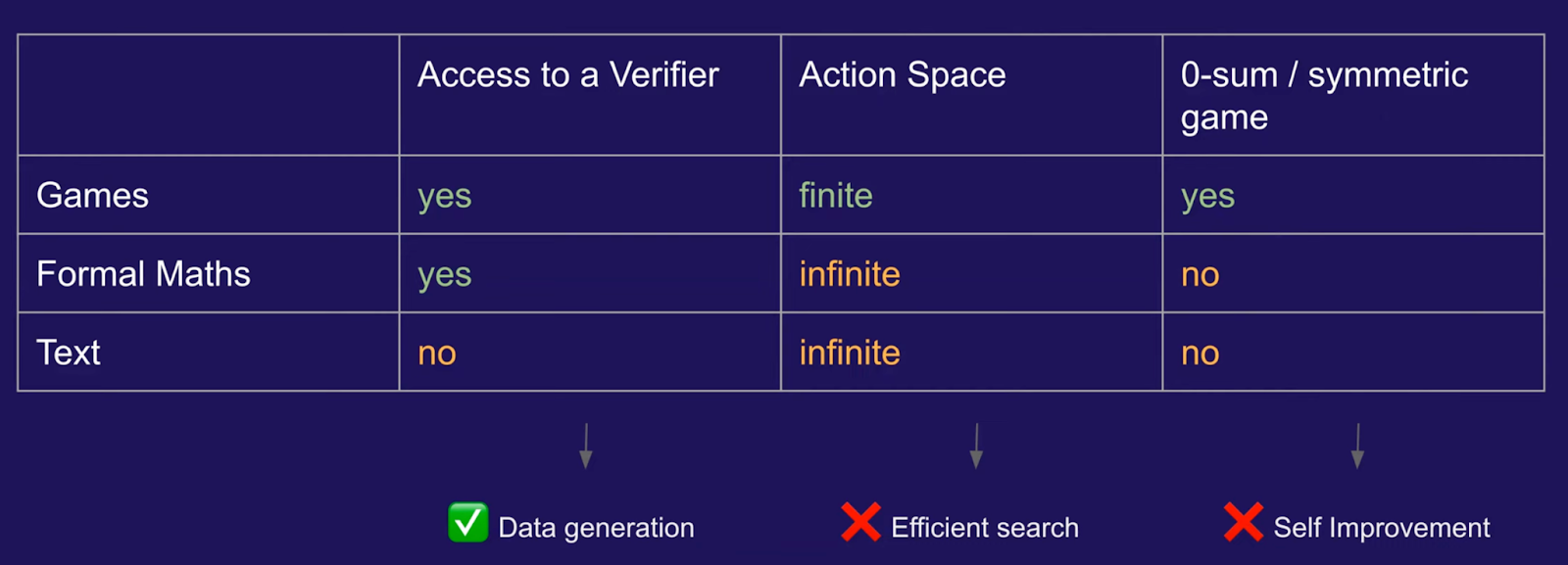
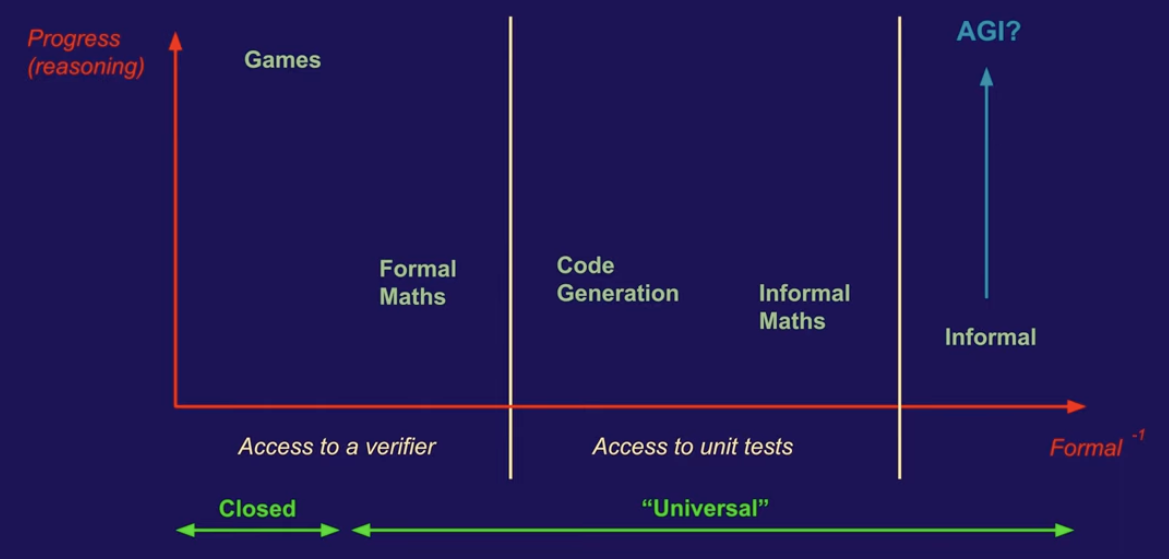
This will probably be true for some scientific areas like automated theorem proving too, since we can verify proofs once formalized (e.g., in the context of an interactive theorem prover like Lean), and thus create entirely within the software a reinforcement-learning-like signal not so different from that from winning a game. So the impact on math could be very large (although there are certainly very non-trivial research challenges along the way).

For many other skills (Type 2), there isn’t an easily accessible game score, simulation or RL signal. But there is ample demonstration data. Thus, GPT-3 writing essays and DALL-E synthesizing paintings. For these skills, a given relatively untrained person will be able to access existing “best of humanity” level skills in under 10 seconds on their web browser. (The extent to which reinforcement learning with human feedback is going to be essential for this to work in any given application is unclear to me and may matter for the details.)

So roughly, the impact model for Type 2 skills is “Best of Existing Skills Instantaneously in Anyone’s Browser”.

What are some emerging Type 2 skills we don’t often think of? Use of your computer generally via keyboard and mouse. Every tap on your phone. Every eye movement in your AR glasses. Every vibration of the accelerometer in your smartwatch. The steps in the design of a complex machine using CAD software.

Let’s suppose that near-term AI is like that above, just applied in ~every domain it can be. This probably will have some limitations in practice, but let’s think about it as a conceptual model.

Routine coding has elements of Type 2 and elements of Type 1, and is almost certainly going to be heavily automated. Many more people will be able to code. Even the best coders will get a productivity boost.

Suppose you have a Type 2 skill. Say, painting photo-realistic 3D scenes. A decent number of humans can do it, and hence DALL-E can do it. Soon, millions of people will do prompt generation for that. Enough people will then be insanely good at such prompt generation that this leads to a new corpus of training data. That then gets built into the next model. Now, everyone AI-assisted is insanely good at the skilled prompt generation itself, with nearly zero effort. And so on. So there is clearly a compounding effect.

Even more so for skills closer to Type 1. Say you have an interactive theorem prover like Lean. Following the narrative for Type 2 skills, a GPT-like system learns to help humans generate proofs in the interactive prover software, or to generate those proofs fully automatically. Then many humans are making proofs with GPT. Some are very good at that. Then, the next model learns how to prompt GPT in the same way, so now everyone can do proofs easily at the level of the best GPT-assisted humans. 

Then, the next model learns how to do proofs at the level of the best GPT-assisted model of GPT-assisted humans? But even more so, because with automatic verification of proofs you can get an RL-like signal, without a human in the loop. You can also use language models to help mathematicians formalize their areas in the first place. Math, in turn, is a fantastic testbed for very general AI reasoning. Fortunately, at least some people think that the “math alignment problem” is not very hard, and it will have a lot of applications towards secure and verified software and perhaps AI safety itself.

These figures from Stanislas Polu’s talk at the Harvard New Technologies in Mathematics Seminar are pretty illustrative of how this formal math based testbed could be important for AI itself, too:

What about, say, robotics? The impact on robotics will likely be in significant part via the impact on coding. The software engineers programming robots will be faster. Many more people will be able to program robots more effectively.

But wait, is it true that the robotics progress rate depends mostly on the time spent by people writing a lot of code? Possibly not. You have to actually test the robots in the physical world. Let’s say that the coding part of robotics progress is highly elastic relative to the above “Best of Existing Skills Instantaneously in Anyone’s Browser” model of AI-induced changes in the world, and speeds by 10x, but that the in the lab hardware testing part of robotics is less elastic and only speeds by 2x. Let’s suppose that that right now these two components — the highly elastic coding part of robotics R&D, and the less elastic in the lab testing part — take about the same amount of time, R. That’s R/2/2 + R/2/10 = 3x speedup of robotics overall.

These numbers may be completely wrong, e.g., Sim2Real transfer and better machine vision may be able to reduce a lot more in-the-lab testing than I’m imagining, but I’m just trying to get to some kind of framework for writing back of the envelope calculations in light of the clear progress in language models.

Suppose that the above factors lead soon to 3x increased rate of progress in robotics generally. Once this 3x speedup kicks in, if we were 30 years away from robots that could do most of the highly general and bespoke things that humans do in a given challenging setting, such as a biology lab, we are now perhaps roughly 

[10 years of accelerated robotics progress away: to get the baseline general robotics capability otherwise expected 30 years from now] 

+ [say one (accelerated) startup lifetime away: from adapting and productizing that to the very specific bio lab use case, say 2 years] 

+ [how long it takes this accelerated progress to kick in, starting where we are now, say 2 years] 

+ [how long it takes for bio at some reasonable scale to uptake this, say another 2 years]. 

So that means we are perhaps about 10 to 15 years away from a level of lab automation that we’d be expecting otherwise 30+ years from now (in the absence of LLM related breakthroughs), on this simple model. 

Let’s say this level of automation lets one person do what 10 could previously do, in the lab, through some combination of robotics in the lab per se, software control of instruments, programming of cloud labs and external services relying on more bespoke software-intensive automation. Is that right? I don’t know. Note that in the above, this is still dominated by the general robotics progress rate, so to the extent that AI impacts robotics progress other than just via speeding up coding, say, or that my above numbers are too conservative, this could actually happen sooner.

We haven’t talked about Type 3 skills yet. We’ll come back to those later. 

Elastic and inelastic tasks relative to general automation

What about science generally? Here I think it is useful to remember what Sam Rodriques recently posted about

https://www.sam-rodriques.com/post/why-is-progress-in-biology-so-slow

namely that there are many factors slowing down biology research other than the brilliance of scientists in reading the literature and coming up with the next idea, say.

Consider the impact of the above robotic lab automation. That’s (in theory at least) very helpful for parts of experiments that are basically human labor, e.g., cloning genes, running gels. The human labor heavy parts of R&D are very elastic relative to the “Best of Existing Skills in Anyone’s Browser” model of near term AI impacts, i.e., they respond to this change with strong acceleration. A lot of what is slow about human labor becomes fast if any given human laborer has access to a kind of oracle representing the best of existing human skills, in this case represented by a robot. Consider, for example, the time spent training the human laborer to learn a manual skill — this disappears entirely, since the robot can boot up with that skill out of the box, and indeed, can do so at a “best of humanity” level.

Certain other parts of what scientists do are clearly at least somewhat elastic relative to “Best of Existing Skills in Anyone’s Browser”. Finding relevant papers given your near-term research goals, digesting and summarizing the literature, planning out the execution of well-known experiments or variants of them, writing up protocols, designing DNA constructs, ordering supplies, hacking together a basic data visualization or analysis script, re-formatting your research proposal for a grant or journal submission template, writing up tutorials and onboarding materials for new students and technicians, making a CAD drawing and translating it to a fabrication protocol, designing a circuit board, and so on, and so forth.

Given the above, it is easy to get excited about the prospects for accelerated science (and perhaps also quite worried about broader economic disruption, perhaps the need for something like universal basic income, and so on, but that’s another subject). Especially considering that what one lab can do depends positively on what other labs can do, since they draw continually on one another’s knowledge. Should we see an increased rate of progress, but not just linearly, rather in a change to  the time constant of an exponential? How should we model the effect of the increased single-lab or single person productivity, due to the effects of broad Best of Existing Skills Instantaneously in Anyone’s Browser capabilities?

But what about parts of scientific experiments that are, e.g., as an extreme example, something like “letting the monkeys grow old”? These are the “inelastic” parts. If we need to see if a monkey will actually get an age-related disease, we need to let it grow old. That takes years. This speed isn’t limited by access to previously-rare-and-expensive human skills. The monkey lifecycle is just what it is. If we want to know if a diagnostic can predict cancer 20 years before it arises, then at least naively, we’ll need to wait 20 years to find out if we’re right. We’ll be able to come up with some surrogate endpoints and predictors/models for long-timescale or other complex in-vivo biology (e.g., translation of animal findings to humans), but they’ll still need to be validated relative to humans. If we want in-silico models, we’ll need massive data generation to get the training data, often at a level of scale and resolution where we don’t have existing tools. That seems to set a limit on how quick the most relevant AI-accelerated bio progress could be.

Sometimes there are clever work-arounds, of course, e.g., you don’t necessarily need to grow full plants to usefully genetically engineer plants, and in the “growing old” example, one can use pre-aged subjects and study aging reversal rather than prevention/slowing. In fact, coming up with and validating those kinds of work-arounds may itself be what is ultimately rate-limiting. FRO-like projects to generate hard-to-get ground truth data or tooling to underpin specific uses of AI (like making a universal latent variable model of cellular state) in science may be one fruitful avenue. Concerned that the clinical trial to test a new cell therapy is going to be expensive and dangerous – maybe try a cell therapy with a chemical off-switch instead. How inelastic must inelastic be, really?

Type 3 skills?

Finally, what about “Type 3” skills? On the one hand, someone could say, “science” requires more than just existing “best of humanity level” skills. What scientists do is NOT just practice skills that other people already have. It is not enough to just make routine and fast on anyone’s web browser something that humanity at large already knows, because science is about discovering what even humanity at large does not know yet. What scientists are doing is creating new ideas that go beyond what humanity in aggregate already knows. So “science” is not a Type 1 or Type 2 skill, one might say, it is a “Type 3 skill”, perhaps, i.e., one that does not come from simply imitating the best of what humanity at large already knows and has documented well, but rather extends the all-of-humanity reach out further. Furthermore, as Sam points out, a lot of the literature is basically wrong (or severely incomplete) in bio, so logic based on the literature directly to scientific conclusions or even correct hypotheses may not get you all that far. Furthermore, LLMs currently generate a lot of incorrect ramblings and don’t have a strong “drive towards truth” as opposed to just a “drive to imitate what humans typically do”.

On the other hand, much of what scientists actually spend their time on is not some essentialized novel truth generating insight production galaxy brain mind state per se, but rather things like making an Excel spreadsheet to plan your experiment and the reagents you need to order and prepare. Enumerating/tiling a space of possibilities and then trying several. Visualizing data to find patterns. Finding and digesting relevant literature. Training new students so they can do the same. Furthermore, as mentioned, in certain more abstruse areas of science, like pure math, we have the possibility of formal verification. So theoretical areas may see a boost of some kind too to the extent that they rely on formal math, perhaps seeing in just a few years the kind of productivity boost that came from Matlab and Mathematica over a multi-decade period. A lot of science can be sped up regardless of whether there are real and important Type 3 skills.

Are there real Type 3 skills? Roger Penrose famously said that human mathematical insight is actually uncomputable (probably wrong). But in the above it seems like we can accelerate formal math in the context of interactive theorem provers. Where is the Type 3 math skill? In the above we also said that a lot of what seems like Type 3 science skill is just an agglomeration of bespoke regular skills. I’d like to hear people’s thoughts on this. I bet Type 3 skills do very much exist. But how rate limiting are they for a given area of science?

More bespoke, and direct, AI applications in science

This is not to mention other more bespoke applications of AI to science. Merely having the ability to do increasingly facile protein design has unblocked diverse areas from molecular machine design to molecular ticker-tape recording in cells. This is now being boosted by generative AI, and there are explicit efforts to automate it. (Hopefully, this will help quickly bring a lot of new non-biological elements into protein engineering, and thus help the world’s bioengineers move away from autonomously self-replicating systems, partially mitigating some biosafety and biosecurity risks.)

There isn’t the space here to go over all the other exciting boosts to specific areas of science that come from specific areas of deep learning, as opposed to more general automation of human cognition as we’re considering with language models, their application to coding, and so on. Sequence to sequence models for decoding mass spectrometry into protein sequences, predicting antigens from receptor sequences, stabilizing fusion plasmas, density functional theory for quantum chemistry calculations, model inference, representations of 3D objects and constructions for more seamless CAD design… the list is just getting started. Not to mention the possible role of “self-driving labs” that become increasingly end-to-end AI driven, even if in narrower areas? It seems like we could be poised for quite broad acceleration in the near term just given the agglomeration of more narrow deep learning use cases within specific research fields.

Inhabiting a changing world

We haven’t even much considered ML-driven acceleration of ML research itself, e.g., via “AutoML” or efficient neural architecture search, or just via LLMs taking a lot of the more annoying work out of coding.

A recent modeling paper concludes that: “We find that deep learning’s idea production function depends notably more on capital. This greater dependence implies that more capital will be deployed per scientist in AI-augmented R&D, boosting scientists’ productivity and economy more broadly. Specifically our point estimates, when analysed in the context of a standard semi-endogenous growth model of the US economy, suggest that AI-augmented areas of R&D would increase the rate of productivity growth by between 1.7- and 2-fold compared to the historical average rate observed over the past 70 years”

In any case, it seems that there could be a real acceleration in the world outside of software and tech, from generative AI. But “inelastic” tasks, and fundamentally missing data, within areas like biology, may still set a limit on the rate of progress, even with AI acceleration of many scientific workflows. It is worth thinking about how to unblock areas of science that are more inelastic.

In this accelerated world model, I’m (somewhat) reassured that people are thinking about how to push forward beneficial uses of this technology, and how to align society to remain cooperative and generative in the face of fast change.

Acknowledgements

Thanks to Eric Drexler, Sam Rodriques and Alexey Guzey, as well as Erika De Benedectis, Milan Cvitkovic, Eliana Lorch and David Dalrymple for useful discussions that informed these thoughts (but no implied endorsement by them of this post).

Selected mentions of the Focused Research Organization (FRO) concept online

convergentresearch.org

e11.bio

cultivarium.org

https://www.nature.com/articles/d41586-022-00018-5

https://www.macroscience.org/p/metascience-101-ep4-arpas-fros-and

https://www.forbes.com/sites/alexknapp/2023/03/17/why-billionaires-ken-griffin-and-eric-schmidt-are-spending-50-million-on-a-new-kind-of-scientific-research/?sh=7bd83bbb2847

lhttps://www.schmidtfutures.com/schmidt-futures-and-ken-griffin-commit-50-million-to-support-the-next-big-breakthroughs-in-science/

https://en.m.wikipedia.org/wiki/Convergent_Research

https://www.nature.com/articles/d41586-024-00928-6

https://www.metaculus.com/tournament/fro-casting/

https://scienceplusplus.org/metascience/index.html

https://www.sciencedirect.com/science/article/pii/S0092867423013272?dgcid=author

https://www.nature.com/articles/d41586-024-02080-7

https://www.gov.uk/government/publications/research-ventures-catalyst-successful-applications/research-ventures-catalyst-successful-applications

https://ariaresearch.substack.com/p/meet-our-activation-partners-driving?utm_source=X&utm_campaign=Activation%20Partners

https://evebio.org/data

https://www.theguardian.com/science/2025/jan/20/brain-implant-boost-mood-ultrasound-nhs-trial

https://www.bloomberg.com/news/articles/2024-12-03/ex-google-ceo-wants-to-learn-about-brains-by-infecting-them

https://e11.bio/news/roadmap

https://www.macroscience.org/p/metascience-101-ep3-the-scientific

https://aria.org.uk (“BUILD” or “focused research unit”)
https://www.gov.uk/government/news/plan-to-forge-a-better-britain-through-science-and-technology-unveiled

https://www.gov.uk/government/publications/research-ventures-catalyst-successful-applications

https://www.lesswrong.com/posts/5JJ4AxQRzJGWdj4pN/building-big-science-from-the-bottom-up-a-fractal-approach

https://www.asimov.press/p/levers

https://press.asimov.com/articles/mouse-microscope

worth.com/tom-kalil-renaissance-philanthropy-wealthy-science-funders/

https://www.bnnbloomberg.ca/business/company-news/2024/11/11/how-a-winning-bet-on-crypto-could-transform-brain-and-longevity-science

https://osf.io/preprints/metaarxiv/9nb3u

https://www.founderspledge.com/research/everything-against-everything 

https://auchincloss.house.gov/media/in-the-news/congress-should-commit-to-us-biotechnology-leadership

https://twitter.com/SGRodriques/status/1654921083613745152
https://bit.ly/CTP-AdamMarblestone

https://www.punkrockbio.com/p/developing-the-problem-centric-founder

https://www.biorxiv.org/content/10.1101/2023.05.19.541510v2.abstract

https://www.prnewswire.com/news-releases/cultivarium-announces-collaboration-with-atcc-to-expand-repertoire-of-microbes-available-for-the-bioeconomy-301798984.html

https://sciencephilanthropyalliance.org/science-philanthropy-indicators-report/


https://www.youtube.com/watch?v=ekYeqvMcaWQ


https://fas.org/publication/focused-research-organizations-a-new-model-for-scientific-research/

https://www.philanthropy.com/article/quick-grants-from-tech-billionaires-aim-to-speed-up-science-research-but-not-all-scientists-approve

https://www.sam-rodriques.com/post/optical-microscopy-provides-a-path-to-a-10m-mouse-brain-connectome-if-it-eliminates-proofreading

https://twitter.com/SGRodriques/status/1680219753267466240

https://press.asimov.com/articles/cultivarium

https://www.peterzhegin.com/investor-notes-from-the-fields-of-labweek-at-edge-esmeralda/

https://www.sam-rodriques.com/post/academia-is-an-educational-institution

https://www.thetimes.co.uk/article/8cb0c0c2-bb80-11ed-b039-425ba6c60d6d

https://assets.publishing.service.gov.uk/government/uploads/system/uploads/attachment_data/file/1140211/rdi-landscape-review.pdf

https://tytonpartners.com/voices-of-impact-tom-kalil-schmidt-futures-2/ 
https://www.thendobetter.com/arts/2022/11/15/michael-nielsen-metascience-how-to-improve-science-open-science-podcast?format=amp

https://www.philanthropy.com/article/quick-grants-from-tech-billionaires-aim-to-speed-up-science-research-but-not-all-scientists-approve

https://ai.objectives.institute/

https://corinwagen.github.io/public/blog/20221026_structural_diversity.html

https://thegeneralist.substack.com/p/modern-meditations-caleb-watney

https://hospitalnews.com/addressing-the-global-antiviral-deficit/

https://xcorr.net/2022/11/03/how-do-science-startups-actually-work/

https://www.notboring.co/p/gassing-the-miracle-machine

https://nadia.xyz/science-funding

https://nadia.xyz/idea-machines

https://nadia.xyz/reports/early-stage-science-funding-asparouhova-jan-2023.pdf
https://mobile.twitter.com/ProtoResearch/status/1504587632948482049

https://www.fastcompany.com/90684882/these-focused-research-organizations-are-taking-on-gaps-in-scientific-discovery

https://www.forbes.com/sites/johncumbers/2023/02/15/ben-reinhardt-is-on-a-mission-to-make-sci-fi-a-reality/?sh=240e12fe4148

https://www.nature.com/articles/s42254-022-00426-6
https://inews.co.uk/opinion/too-much-good-science-never-gets-funded-heres-something-that-might-help-fix-that-1777792

https://institute.global/policy/new-model-science
https://progress.institute/fund-organizations-not-projects-diversifying-americas-innovation-ecosystem-with-a-portfolio-of-independent-research-organizations/
https://logancollinsblog.files.wordpress.com/2021/05/list-of-biotechnology-companies-to-watch-1.pdf

https://overlapholdings.substack.com/p/brave-capital-a-mini-manifesto?utm_source=profile&utm_medium=reader2
https://progress.institute/progress-is-a-policy-choice/

https://manifund.org/projects/optimizing-clinical-metagenomics-and-far-uvc-implementation

https://endpts.com/inside-the-multibillion-dollar-silicon-valley-backed-effort-to-reimagine-how-the-world-funds-and-conducts-science/

https://twitter.com/SGRodriques/status/1447976944948088832

https://noahpinion.substack.com/p/interview-jason-crawford-nonprofit

https://elidourado.com/blog/geothermal/

http://gaia.cs.umass.edu/NNRI/

https://applieddivinitystudies.com/FRO/

https://www.geroscience.health/white-paper

https://www.economist.com/united-states/2021/06/05/congress-is-set-to-make-a-down-payment-on-innovation-in-america

https://mobile.twitter.com/JvNixon/status/1404808694278279183

https://dweb.news/2021/09/05/technology-on-beaming-solar-power-from-low-earth-orbit/

https://innovationfrontier.org/geothermal-everywhere-a-new-path-for-american-renewable-energy-leadership/

https://podcasts.apple.com/au/podcast/adam-marblestone-ben-reinhardt-fro-parpa-innovating/id1573395849?i=1000539374581

https://www.sciencefutures.org/resources/

https://leadegen.com/index.php/frontiers/7-tom-kalil/

https://astera.org/fros/

http://tib.matthewclifford.com/issues/tib-134-technological-sovereignty-why-we-dream-the-missing-piece-in-r-d-and-more-281762

https://ideamachinespodcast.com/adam-marblestone-ii

https://austinvernon.site/blog/drillingplan.html

https://rootsofprogress.org/how-to-end-stagnation

https://www.lawfareblog.com/chinatalk-tough-tech-roombas-valleys-death-and-woolly-mammoths

https://nintil.com/bottlenecks-workshop/

https://www.scibetter.com/interview/ricon

https://foresight.org/salon/aging-ecosystem-multipliers-focused-research-orgs-adam-marblestone-schmidt-futures-fellow/

https://arbesman.net/overedge/

https://corinwagen.github.io/public/blog/20230717_fmufros.html

https://rootsofprogress.org/a-career-path-for-invention

https://ntc.columbia.edu/wp-content/uploads/2021/04/National-Brain-Observatory.pdf

https://www.dayoneproject.org/post/focused-research-organizations-to-accelerate-science-technology-and-medicine

https://dash.harvard.edu/handle/1/42029733

https://dspace.mit.edu/handle/1721.1/123401

Related:


https://www.lesswrong.com/posts/mHqQxwKuzZS69CXX5/whole-brain-emulation-no-progress-on-c-elgans-after-10-years?commentId=GBvdQoNG7L2vqPu3v

https://moalquraishi.wordpress.com/2020/12/08/alphafold2-casp14-it-feels-like-ones-child-has-left-home/#s5
“Resources also helped and this is not to be underestimated, but I would like to focus on organizational structure as I believe it is the key factor beyond the individual contributors themselves. DeepMind is organized very differently from academic groups. There are minimal administrative requirements, freeing up time to do research. This research is done by professionals working at the same job for years and who have achieved mastery of at least one discipline. Contrast this with academic labs where there is constant turnover of students and postdocs. This is as it should be, as their primary mission is the training of the next generation of scientists. Furthermore, at DeepMind everyone is rowing in the same direction. There is a reason that the AF2 abstract has 18 co-first authors and it is reflective of an incentive structure wholly foreign to academia. Research at universities is ultimately about individual effort and building a personal brand, irrespective of how collaborative one wants to be. This means the power of coordination that DeepMind can leverage is never available to academic groups. Taken together these factors result in a “fast and focused” research paradigm.

AF2’s success raises the question of what other problems exist that are ripe for a “fast and focused” attack. The will does exist on the part of funding agencies to dedicate significant resources to tackling so-called grand challenges. The Structural Genomics Initiative was one such effort and the structures it determined set the stage, in part, for DeepMind’s success today. But all these efforts tend to be distributed. Does it make sense to organize concerted efforts modeled on the DeepMind approach but focused on other pressing issues? I think so. One can imagine some problems in climate science falling in this category.

To be clear, the DeepMind approach is no silver bullet. The factors I mentioned above—experienced hands, high coordination, and focused research objectives—are great for answering questions but not for asking them, whereas in most of biology defining questions is the interesting part; protein structure prediction being one major counterexample. It would be short-sighted to turn the entire research enterprise into many mini DeepMinds.

There is another, more subtle drawback to the fast and focused model and that is its speed. Even for protein structure prediction, if DeepMind’s research had been carried out over a period of ten years instead of four, it is likely that their ideas, as well as other ideas they didn’t conceive of, would have slowly gestated and gotten published by multiple labs. Some of these ideas may or may not have ultimately contributed to the solution, but they would have formed an intellectual corpus that informs problems beyond protein structure prediction. The fast and focused model minimizes the percolation and exploration of ideas. Instead of a thousand flowers blooming, only one will, and it may prevent future bloomings by stripping them of perceived academic novelty. Worsening matters is that while DeepMind may have tried many approaches internally, we will only hear about a single distilled and beautified result.

None of this is DeepMind’s fault—it reflects the academic incentive structure, particularly in biology (and machine learning) that elevates bottom-line performance over the exploration of new ideas. This is what I mean by stripping them from perceived academic novelty. Once a solution is solved in any way, it becomes hard to justify solving it another way, especially from a publication standpoint.”

Notes on indoor food production, life support for space colonies, “refuges”, “biobox”, and related

Epistemic status: initial stab from a non-expert

Thanks to Shannon Nangle and Max Schubert for helpful discussions. 

Summary:

There are a variety of potential scenarios where a self-sustaining, biologically isolated Refuge would be needed towards existential risk reduction. 

Currently, there is very little work going on towards technical common denominators required for all such approaches, e.g., highly efficient and compact indoor food production. 

Shallow overview of prior writings related to the BioBox/Refuge concept:

There are a number of concepts floating around about Refuge or “Bio Box” that gesture at different design criteria.

There is the abstract concept around bio-risk

https://www.fhi.ox.ac.uk/wp-content/uploads/1-s2.0-S0016328714001888-main.pdf

There is the Carl Shulman blog version

http://reflectivedisequilibrium.blogspot.com/2020/05/what-would-civilization-immune-to.html

Shulman envisions greatly increased wealth or cost-benefit calculus motivating society to equip many standard living and working spaces with BSL-4 level biosafety precautions, e.g., “large BSL-4 greenhouses”. This does not address the issue of radical improvements in the density or autonomy of food production or waste management, but rather proposes the use of advanced filtering and sterilization procedures in the context of more conventional infrastructure.  

There are old BioSphere 2 projects, which include a lot of extraneous stuff up front, like goats and waterfalls — these are arguably not technically focused enough to drive the core capability advancements needed for a Refuge

https://biosphere2.org/

There is the notion of a regenerative life-support system for space, e.g., for future space stations. This bleeds into the notion of a bio-regenerative life-support system where a large number of essential regenerative functions, e.g., waste recycling or gas balance functions are done by biological organisms, e.g., MELISSA, BIOS-3

https://en.wikipedia.org/wiki/MELiSSA

MELISSA stands for micro-ecological life support system ALTERNATIVE, where “alternative” means it is using biology for some aspects where, for example, the International Space Station would use more conventional chemical engineering methods. See: 

https://www.youtube.com/watch?v=PHTVep3Fik0

http://www.sciencedirect.com/science/article/pii/S0168165602002225

There is the notion of a food production and waste recycling system roadmap for early Mars colonies

https://www.nature.com/articles/s41587-020-0485-4

See Except below.

While optimized for the Martian setting, they point to core technology problems that may be relevant for Earth-based refuges, including efficient indoor food production, and have led to some roadmapping work taxonomizing where biological versus non-biological solutions could be most useful in a simplified, minimal closed habitat.

There is simply the idea of highly efficient indoor food production to protect against risks to the food supply.

There is the idea of nuclear submarines being able to operate and hide ~indefinitely as a deterrent to attacks, by having a Refuge on board.

There is the notion of using Refuges as a way of maintaining other defensive or counter-offensive biotech capabilities in a safe space, e.g., if a Refuge is where we keep our vaccine/countermeasure synthesis capacity.

Within all this there are parameters including whether it is totally sealed, size, number of people supported, comfort level supported, and so on. 

There is the George Church version of BioBox which is closest to a modern idea for fully closed bio-regenerative life support system on Earth, building on MELISSA, but with an emphasis on photosynthesis and certain unconventional applications in mind. This proposes to use photosynthetic microbes as a food source, in contrast to the Nagle et al first stage Mars plan which proposes to use methanol-using heterotrophic and CO2-using lithoautotrophic fermentation.

Finally there is the idea of pushing relevant (e.g., compact indoor food production) technologies by first developing economically viable products (such as niche food products for consumers).

Then there is the “hydrogen oxidizing bacteria” (HOB) approach — see these papers:

Alvarado, Kyle A., et al. “Food in space from hydrogen-oxidizing bacteria.” Acta Astronautica 180 (2021): 260-265.

Martínez, Juan B. García, et al. “Potential of microbial protein from hydrogen for preventing mass starvation in catastrophic scenarios.” Sustainable production and consumption 25 (2021): 234-247.

Nangle, Shannon N., et al. “Valorization of CO2 through lithoautotrophic production of sustainable chemicals in Cupriavidus necator.” Metabolic Engineering 62 (2020): 207-220.

Liu, Chong, et al. “Water splitting–biosynthetic system with CO2 reduction efficiencies exceeding photosynthesis.” Science 352.6290 (2016): 1210-1213.

Chen, Janice S., et al. “Production of fatty acids in Ralstonia eutropha H16 by engineering β-oxidation and carbon storage.” PeerJ 3 (2015): e1468.

From a Denkenberger paper: “The main companies currently pioneering mass production of H₂ SCP are: SolarFoods, NovoNutrients, Avecom, Deep Branch Biotechnology [looks like they are making animal feed], Kiverdi [“air protein”] and LanzaTech [making Omega3 fatty acids from CO2, for one thing]…”. See also, notably, Circe

Other more mature aspects of life support systems outside food production

https://www.nasa.gov/content/life-support-systems

https://www.esa.int/Science_Exploration/Human_and_Robotic_Exploration/Concordia

https://patents.google.com/patent/WO1998025858A1/en

https://ntrs.nasa.gov/api/citations/20060005209/downloads/20060005209.pdf

https://www.nasa.gov/pdf/473486main_iss_atcs_overview.pdf

https://www.nasa.gov/centers/marshall/pdf/104840main_eclss.pdf

Note: the ISS imports food and some water from Earth but recycles other things like oxygen, as I understand it

Relevant excerpt from The Case for Biotechnology on Mars (Nangle et al):

“Recent advances in fermentative production of flavors, textures and foods can form the basis for new Mars-directed engineering efforts. Successful deployment will require the in-tandem development of organisms and fermenters for Martian conditions; the system must use CO2 and CH3OH as its sole carbon sources, accommodate unreliable solar irradiance and tolerate the potential presence of contaminants in water and regolith. To support this development, we propose scaling Martian food production in three stages: Stage I involves lithoautotrophic and heterotrophic fermentation; Stage II involves photoautotrophic fermentation and small-scale crop growth; and Stage III involves large-scale crop cultivation. 

Stage I. Both methanol-using heterotrophic and CO2-using lithoautotrophic fermentation will be used to complement the crew’s diet and serve as an initial demonstration of Martian food production. 

Fermentation technologies also have the added benefit of shorter boot-up and production timelines (days to weeks) compared with the production of staple plant crops (weeks to months). Fermentation can be carried out in simple stir tanks or airlift reactors that use engineered organisms to produce complex carbohydrates and proteins40,41. Several suitable methylotrophic organisms, such as Methylophilus methylotrophus and Pichia pastoris, are already genetically characterized, industrially optimized and extensively deployed for large-scale production. Methylotrophic genes have also been heterologously expressed in model organisms such as Escherichia coli and Bacillus subtilis41. Such organisms can be engineered to produce a wealth of ingredients, including flavors, protein, organic acids, vitamins, fatty acids, gums, textures and polysaccharides41. Bioreactors with these organisms have very high process

intensities, with a single 50-m3 reactor able to produce as much protein as 25 acres of soybeans, with only a few days to the first harvest42–44. CO2-using lithoautotrophs could similarly be engineered to couple their hydrogen oxidation and CO2 fixation into oligosaccharides, protein and fatty acid production. 

Maximizing yields in these microbial chassis and adapting the above organisms to Martian minimal medium remain key challenges. Initial applications can focus on small-scale sources of backup calories and on establishing benchmarks for subsequent larger-scale implementation. Demonstration of aero- and hydroponic systems to grow spices, herbs and greens would be explored in this stage45.

Stage II. The second stage focuses on introducing photoautotrophs to synthesize food. With increasing investment in Martian infrastructure, more complex bioreactors can be deployed to grow green algae rich in carbohydrates, fatty acids and protein46. Several well-developed terrestrial examples of algal industrialization exist, such as Arthrospira platensis for food or commercial algal biofuels47. On Earth, the high capital costs of building reactors and supplying high concentrations of CO2 for optimal production are commercially challenging. On Mars, however, this challenge becomes an advantage: the CO2-rich atmosphere can be enclosed and pressurized for algal growth.

As photoautotrophic growth is scaled to meet more nutritional requirements of the crew, maintaining reliable production despite the weaker Martian sunlight and planet-engulfing dust storms will be a key challenge, requiring surface testing of several reactor designs. We do not anticipate using natural sunlight as an energy source for photoautotrophs at these stages because it alone is insufficient for growth: once solar photons have passed through greenhouse materials, photoautotrophs would receive around 17 mol m–2sol–1—up to fourfold less than their typical minimal requirements35,48.

Thus, at this stage, photosynthetic organisms would be grown in photobioreactors or growth chambers with optimized artificial lighting. For longer habitation, the psychological benefits of having living plants and familiar foods are substantial49….”

Cyanobacterial food

https://wyss.harvard.edu/news/max-schubert-on-fast-growing-cyanobacteria/

But is the cyanobacterial path the right one? To compare the hydrogen oxidizing bacteria (HOB) approach with a photosynthetic microalgae or cyanobacteria approach, consider this quote from one of the Denkenberger papers: “Electricity to biomass efficiencies were calculated for space to be 18% and 4.0% for HOB [hydrogen oxidizing bacteria] and microalgae, respectively. This study indicates that growing HOB is the least expensive alternative. The [equivalent system mass] of the HOB is on average a factor of 2.8 and 5.5 less than prepackaged food and microalgae, respectively.” So HOB is significantly more efficient, per this analysis. 

The supplemental materials of the Metabolic Engineering paper includes this comparison with cyanobacterial food production:

“Comparison to cyanobacterial co-culture systems

As bioproduction technologies have expanded, co-culture and cross-feeding has been explored as a possible solution to lower feedstock costs while supporting the existing infrastructure of engineered heterotrophs. Efforts towards autotrophic-heterotrophic co-cultures have primarily focused on cyanobacteria as the autotroph 1,2 . Cyanobacteria are an obvious choice as they natively produce sucrose as an osmoprotectant—rather than a carbon

source—to high concentrations without toxicity, making it an attractive feedstock-producer for heterotrophs. Engineered cyanobacterial strains able to convert and export up to 80% of their fixed carbon successfully fed three phylogenetically distinct heterotrophic microbes (E. coli, B.

subtilis, and S. cerevisiae) 3 . However, cyanobacteria produce reactive oxygen species through photosynthesis and protective cyanotoxins, which are ultimately toxic to the heterotrophs. While cyanobacteria have higher solar-to-biomass conversion efficiencies than plants, efficiency remains 5-7% and is thermodynamically limited to ~12%—several fold lower than photovoltaics 4. In addition to their biological limitations, there are a variety of implementation constraints that hinder industrial scale-up. Because cyanobacteria grown at scale require sunlight, two common culturing methods allow for optimal sunlight penetration: pools and photobioreactors. The large shallow pools can only be used in certain regions, are susceptible to environmental changes and contamination—and so it is difficult to maintain consistent batch-to-batch cultivation. In an effort to mitigate some of these issues, these pools can be modified to grow the cyanobacteria in small diameter tubing, but this kind of containment often deteriorates from radiation exposure as well as generates substantial plastic waste 5 . Because these issues4 are all challenges for cyanobacteria monoculture, it is not clear how a co-culture system would be successfully implemented at scale.”

See here for more on comparison with using cyanobacteria:

https://microbialcellfactories.biomedcentral.com/articles/10.1186/s12934-018-0879-x

https://science.sciencemag.org/content/332/6031/805

I am not an expert here but this seems to basically be saying photosynthesis is not actually that great compared to what can be done with other kinds of conversion. 

Note: other comparisons could be made to other food from gas and food from woody biomass approaches. 

A counter-argument against this kind of industrial instrumentation and bioengineering heavy approach is that in some catastrophic scenarios on Earth, e.g., post nuclear, one might have very limited infrastructure capacity and one could perhaps instead be focusing on producing sufficient food from woody biomass with sufficient net gain to the human workers doing a lot of stuff by hand in that scenario (no power grid, no chemical manufacturing whatsoever, no good temperature control systems, etc)? 

This addresses a scenario relevant to post-apocalyptic (nuclear winter) food production but not necessarily the Refuge/BioBox scenario per se.

Some questions:

Q: Is efficient indoor food production from simple feedstocks indeed the “long pole in the tent”, technically, for a Refuge/BioBox/closed life support system in general?

Other parts of life support do seem more solved, e.g., from work done by the International Space Station teams: 

https://patents.google.com/patent/WO1998025858A1/en

https://ntrs.nasa.gov/api/citations/20060005209/downloads/20060005209.pdf

https://www.nasa.gov/pdf/473486main_iss_atcs_overview.pdf

https://www.nasa.gov/centers/marshall/pdf/104840main_eclss.pdf

Q: What about doing natural gas to food biologically as a means of producing food

https://agfundernews.com/two-startups-converting-methane-into-animal-feed-raise-funding-from-gas-giants-in-europe-asia.html

or coal to food chemically (See: https://www.washingtonpost.com/archive/lifestyle/food/1984/05/27/can-food-be-made-from-coal/d80567ac-c656-4e0b-9f54-d505bd6d261a/)?

Q: Is there value in pushing conventional indoor vertical farming instead? See:

https://www.pnas.org/content/117/32/19131

Much less efficient than using microbes? 

Q: Would we really do direct air (or ocean) capture of CO2 for a refuge on Earth?

One of the Denkenberger papers states: “Electrolysis based H₂ SCP production requires an external carbon source. This study conservatively uses direct air capture (DAC) of CO₂ as the basis of our calculations; however, CO₂ capture from industrial emitters is in most cases less expensive and in some cases can already contain some amount of hydrogen that can be used.”

“​​The nitrogen requirements can be satisfied by using ammonia from the fertilizer industry….”

Notes on sequence programmability in bio-templated electronics

Note: prepared as a response to this RFI.

Response to prompt (b) on Biotemplated Registration capabilities:

b1. What are the physical mechanisms underlying your registration approach(es)?  Include surface chemistry requirements in your discussion.

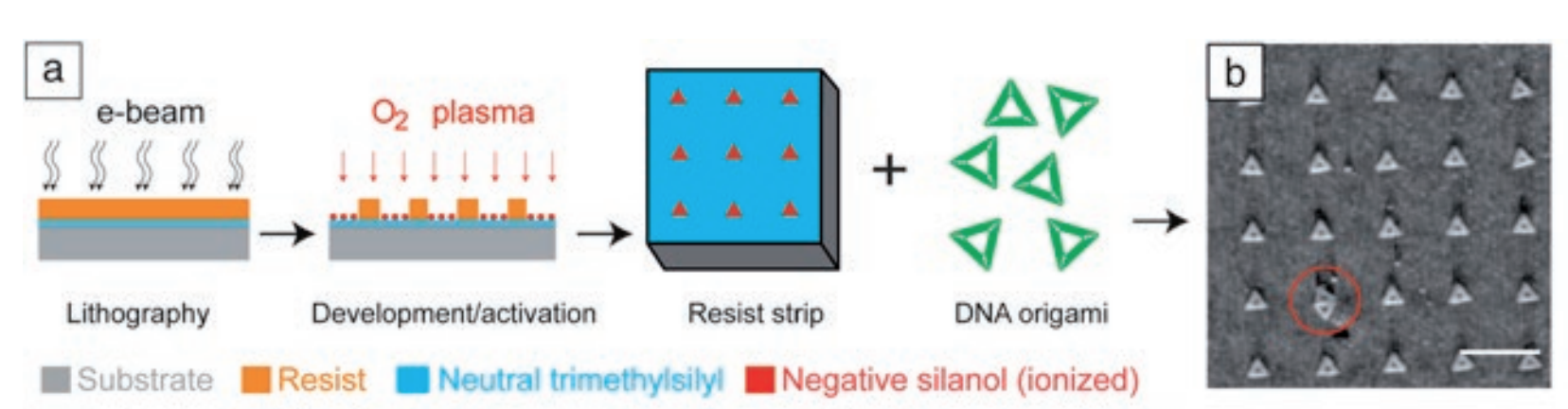
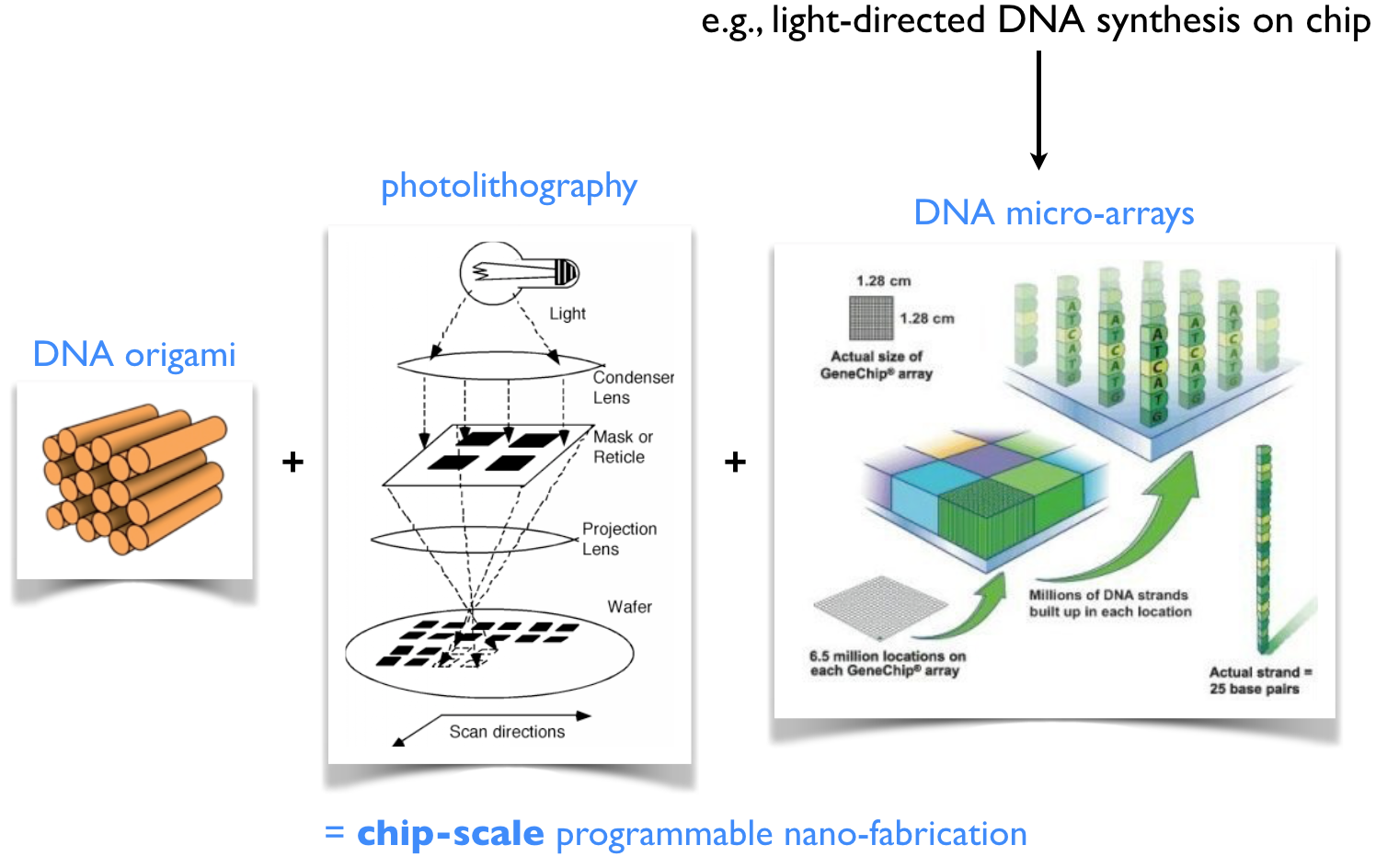
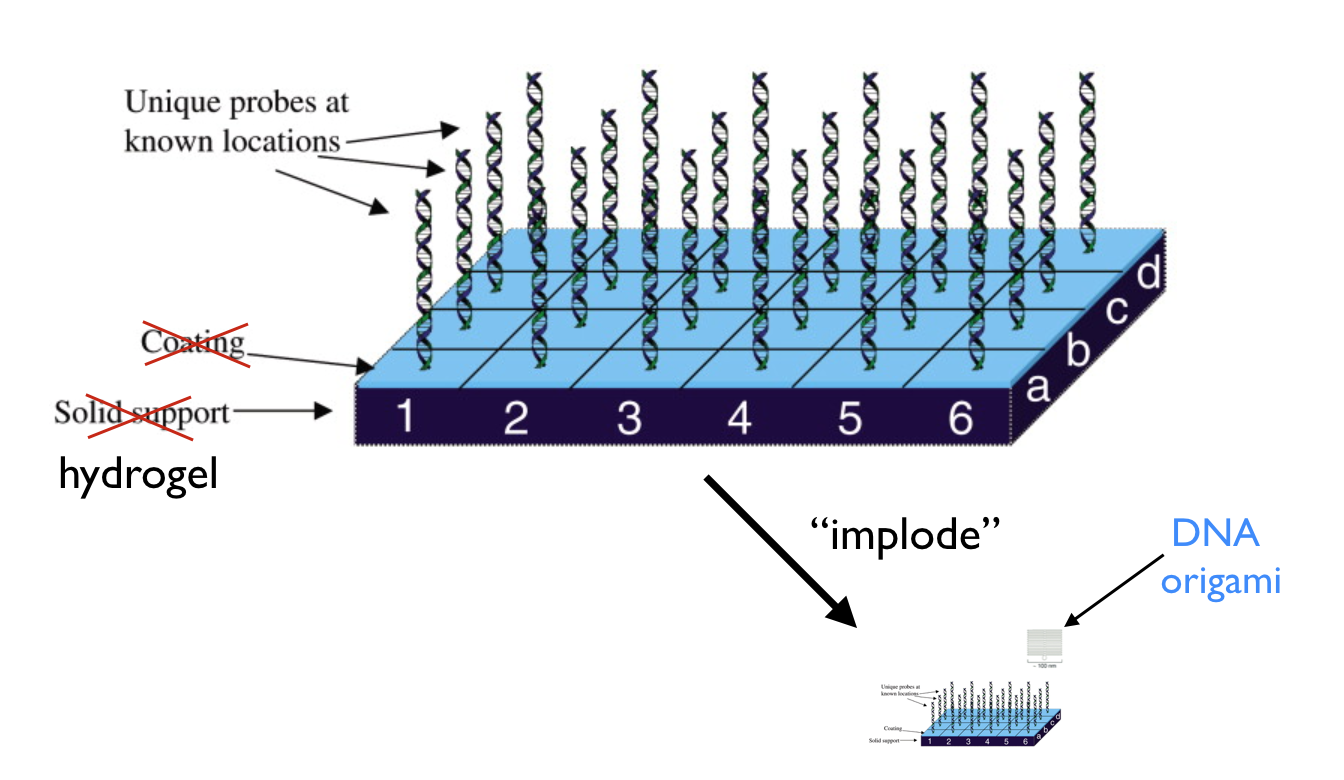
The proposed approach would achieve sequence-specific addressable chips that can direct unique-sequence DNA origami to specific spots on chip with an exponential diversity of sequence programmability rather than a more limited diversity of shape and surface affinity programmability as in previous work. 

To do this, one needs to be able to approximately size-match single DNA origami-like structures with single sequence-specific spots on chip (think of them as localized “forests” of copies of a particular DNA sequence on chip). One way of doing that would be to photo-pattern a sequence-specific DNA microarray, and then shrink the spots with Implosion Fabrication. 

What are the physical principles underlying Implosion Fabrication? It turns out that there are materials called hydrogels that, when you put them in water, can swell uniformly by a large factor, say 10x along each axis. If you add salt, they uniformly shrink back down. Implosion Fabrication uses a focused spot of light to pattern materials into a swollen hydrogel, and then shrink. So you can get 10x better resolution, say, then the smallest diameter of a focused spot of light, i.e., you can get 10’s of nanometer resolution using light with wavelength of hundreds of nanometers. This can be done with a variety of materials, but here is shown just with fluorescent dyes for demonstration purposes:

A key advantage of this approach is that Implosion Fabrication operates directly in three dimensions. 

b2. Does your approach incorporate biomaterials into the resulting device?

It can, in theory, though this depends on the nature of the post-processing, e.g., whether it involves high temperatures. The approach could be adapted for different such scenarios.  

b3. What are the expected capabilities of your registration approach(es) (e.g., location, orientation and geometrical tolerances, pitch, critical dimensions, error in critical dimensions, density multiplication, critical dimension shrinkage)?  Please include a discussion of how computational and metrology resources assist in this approach.

Goal: The key goal would be to take the full addressability within DNA origami — the fact that each staple strand, which goes to a unique site on the origami, with few nanometer precision, say, and can thus bring a unique attached chemical, nanoparticle or so on to that particular site on the origami (the 2007 Battelle roadmap has a good description of this concept, they call it “unique addressing”) — and extend that to an area approaching the size of a computer chip, so say a millimeter on a side instead of 100 nm on a side.

Background: What the current state of the art can do is use electron beam lithography to make small “sticky” spots (I’m glossing over the chemistry obviously) on a silicon surface — and importantly, those spots can have a well defined orientation and be of the exact right size and shape to stick to a shape-matched DNA origami. Like this: note how the DNA origami triangles line up quite well inside the lithographic triangles:

They can then use this to make some basic photonic devices. This is one of those technologies where it feels like it now needs exploration to find its killer app. One possibility is positioning of a small number of discrete photonic components at the right locations on chips, e.g., for single photon sources — there is some progress in that general direction: “the authors were able to position and orient a molecular dipole within the resonant mode of an optical cavity”.

Proposed innovations: The proposed approach would go beyond just matching the shapes of lithographic spots to the shapes of DNA origami, and instead to actually have unique DNA sequences at unique spots that could uniquely bind to a given DNA origami. This would be a combination of a few technologies

In more detail, in my mostly theoretical thesis chapter on “nm2cm” fabrication

http://web.mit.edu/amarbles/www/docs/Marblestone_nm2cm_thesis_excerpt.pdf

http://web.mit.edu/amarbles/www/docs/Bigger-NanoBots-Marblestone.pdf

https://dash.harvard.edu/handle/1/12274513

we proposed that the key gap in this field — of integrating biomolecular self-assembly with top-down nanofabrication to construct chip-scale systems — is that, as impressive are works like Ashwin Gopinath’s using shape to direct DNA origami to particular spots on chips, it would be even more powerful if we could direct specific origami to specific spots on chip in a sequence-specific way: each spot on the chip should have a unique DNA address that could match to a unique DNA origami slated to land there. How can we do that? 

1.1) Optical approaches (faster, cheaper than electron beam lithography) can deposit or synthesize particular DNA sequences at particular spots on chip — and this is widely used to create DNA microarrays — but the spot sizes and spacings of the resulting DNA “forests” are too large to achieve “one origami per spot”

http://www.biostat.jhsph.edu/~iruczins/snp/extra/05.08.31/nbt1099_974.pdf

1.2) So we proposed to combine sequence non-specific but higher resolution photolithography to make small spots, with coarser grained optical patterning to define sequences for those spots, and then large origami rods spanning spot to spot to help ratchet orientation and spacing into a global “crystal-like” pattern: see nm2cm chapter above

Anyway, we didn’t demonstrate much of this experimentally at all (alas, it needed an ARPA program not just a rather clumsy grad student, or at least that would be my excuse!), but since then

1.a) Implosion Fabrication (ImpFab), mentioned above, may now provide a way to take a sequence-specific DNA microarray and shrink it so that the spot size matches achievable sizes of DNA origami. Something like this: note the tiny DNA origami in the lower right for scale

1.b) Researchers have started making smaller/finer-resolution microarray-like sequence-specific (albeit random) patterns on chips, and even transferred them to other substrates

https://www.biorxiv.org/content/10.1101/2021.01.25.427807v1.full

https://www.biorxiv.org/content/10.1101/2021.01.17.427004v1.full

(With these, you make a fine grained but random pattern and then image/sequence it in-situ to back out what is where. This would obviously entail a significant metrology component, i.e., figuring out what sequence is where and then synthesizing a library of adaptor strands to bring the right origami to the right sequences.)

1.c) DNA origami have gotten bigger, too, closer to matching the sizes even of existing non-shrunken microarray spots

https://www.nature.com/articles/nature24655

1.d) Another approach that could be used for fine-grained, sequence specific patterning would be something like ACTION-PAINT. This is in the general category of nanopatterning via “running a microscope in reverse”. Basically, there is a microscopy method called DNA PAINT that works like this. You have some DNA strands on a surface, arranged just nanometers apart from one another, and you want to see how they are all arranged. If you just put fluorescent labels on all of them at once, and look in an optical microscope, then the limited resolution of the optical microscope — set by the wavelength of light, a few hundred nanometers — blurs out your image. But if you can have complementary DNA strands bind and unbind transiently with the strands on the surface, fluorescing only when they bind, and such that at any given time only one is bound, then you can localize each binding event, one at a time, with higher precision than the wavelength (by finding the centroid of a single Gaussian spot at a time). That’s the basic principle of single-molecule localization microscopy, which won a Nobel Prize in 2018

The magic is that you can localize the centroid of one (and only one) isolated fluorescent spot much more precisely than you can discriminate the distance between two (or more) overlapping fluorescent spots. So you rely on having a sparse image at any one time, as DNA molecules bind on and off to different sites on the object such that typically only one site has a bound partner at any given time on, and then you localize each binding event one by one and build up the overall image as a composite of those localizations.

Anyway, that’s a microscopy method that lets you see with resolution down to a couple nanometers, well below the wavelength of light.

But how can you use this for nano-patterning? Well, imagine you have a desired pattern you want to make, and you are doing this “single molecule localization microscopy” process in real time. Then, if you can detect that a DNA strand has bound to a spot that is supposed to be part of your pattern, and you can register this in real time, then you can quickly blast the sample with a burst of UV light which locks that strand in place, preventing it from ever leaving again. That “locks in” a DNA bound to that spot. Now, most of the time, the localizations you’ll see will be at spots you don’t want to be part of your pattern, so you don’t blast the UV light then. But every so often, you’ll see a probe bound at a spot you want to be in the pattern, and when that happens, you take fast action, locking it in. That’s what ACTION-PAINT does:

This can be seen as a kind of molecular printer with in principle roughly the same resolution as that of the underlying single molecular localization microscopy method. Which in practice is not quite as high as the best AFM positioning resolution. But it is pretty high, in the single digit nanometers in the very best case. 

Thus, I think sequence-specific bio-chips, in which thousands of distinct origami as defined by sequences, not just a few as defined by shapes, can be directed to their appropriate spots on chip in a multiplexed fashion, should be possible. Exactly what their killer applications would be is less clear to me as of now.  

b4. How broadly can your approach be applied (i.e., is it limited to a single material and/or device)?

The approach would constitute a general platform for 3D hierarchical multi-material nanofabrication. If developed intensively, many thousands of different DNA origami bearing different functionalizations could in theory be brought to appropriate defined locations in 3D. Orientation of parts would be challenging to achieve but see the “nm2cm” crystal-like annealing process proposed below to above to allow this. Other materials could also be patterned in-situ using the standard implosion fabrication methods. 

b5. What constitutes a defect in your approach?

One could have a) defective origami, b) spots that are not patterned with DNA, c) spots with DNA that do not receive the right origami, d) other larger-scale defects, e.g., non-uniformities in the implosion process if using implosion fabrication, e) orientation defects if aiming to achieve defined orientations, e.g., in something like the nm2cm scheme.

b6. What defect rate and/or density can your approach achieve?

Currently unknown. In theory, layers of error correction could be applied at various levels to reduce defect rates. 

b7. Can defect reduction techniques be applied to your approach and if so, what is the expected impact?

Exact design scheme and quantitative impact not yet clear.

b8. What manufacturing throughput can your approach achieve?

Because it can rely on photolithography rather than electron-beam lithography, and pattern on the origami at the few-nm scale in a massively parallel way, the approach could potentially be very fast, e.g., with holography optical patterning of the initial template to be imploded. 

In general, for all detailed implementation questions here, it should be noted this is more of a set of design concepts and these are quite early-stage. In my mind this would form an ancillary, more speculative part of a program, aiming to seed sequence specific assembly and registration principles beyond the “bread and butter” parts of a program that might involve aspects closer to the published literature on registration in 2D by, for example, Gopinath/Rothemund et al.

b9. What existing nanomanufacturing infrastructure (e.g., tooling, processes) is required to enable your approach?  Are these resources currently available to you?

I am currently doing other kinds of work more on the institutional side. Would suggest doing this via groups like Irradiant Technologies and collaborations with DNA nanotechnology (e.g., Ashwin Gopinanth, William Shih) and DNA microarray fabrication (e.g., Franco Cerrina, Church lab, spatial transcriptomics labs using related methods) groups. In other words, I’m not in a direct position to execute on this experimentally right now.

b10. What computational resources would assist in simulating your approach?  If you could design the ideal computational infrastructure/ecosystem, what would it look like?  Please be quantitative with expected gains from having access to this ecosystem.

Depends on further narrowing down what this gets used for. Computing doesn’t seem to be the key limitation right now for this project. 

b11. In what way(s) are these resources different from what is currently available?

Computing doesn’t seem to be the key limitation right now for this project. 

b12. How and to what magnitude would these computational resources assist your approach (e.g., improving throughput, decreasing defects, predicting device characteristics)?

Computing doesn’t seem to be the key limitation right now for this project. 

b13. What are the expected resource requirements for your approach (e.g., raw materials required, power, water)? 

Comparable to DNA microarray manufacturing. 

b14. What are the expected costs (including waste streams) of your approach and how do they compare to existing approaches?

Comparable to DNA microarray manufacturing. 

b15. What metrology tools are needed to achieve the capabilities of your registration approach?  If you could design the ideal infrastructure/ecosystem, what would it look like? 

Depending on whether one does random patterning of the initial sequences and then reads them out, this may need something like an Illumina sequencing machine to read the locations of the sequences prior to implosion and addition of the DNA origami. 

b16. In what way(s) are these metrology resources different from what is currently available?

Just needs adaptation of detailed protocols. 

References

Oran D, Rodriques SG, Gao R, Asano S, Skylar-Scott MA, Chen F, Tillberg PW, Marblestone AH, Boyden ES. 3D nanofabrication by volumetric deposition and controlled shrinkage of patterned scaffolds. Science. 2018 Dec 14;362(6420):1281-5.

Marblestone AH. Designing Scalable Biological Interfaces (Doctoral dissertation, Harvard, 2014).

Singh-Gasson S, Green RD, Yue Y, Nelson C, Blattner F, Sussman MR, Cerrina F. Maskless fabrication of light-directed oligonucleotide microarrays using a digital micromirror array. Nature biotechnology. 1999 Oct;17(10):974-8.

Cho CS, Xi J, Park SR, Hsu JE, Kim M, Jun G, Kang HM, Lee JH. Seq-Scope: Submicrometer-resolution spatial transcriptomics for single cell and subcellular studies. bioRxiv. 2021 Jan 1.

Chen A, Liao S, Ma K, Wu L, Lai Y, Yang J, Li W, Xu J, Hao S, Chen X, Liu X. Large field of view-spatially resolved transcriptomics at nanoscale resolution. bioRxiv. 2021 Jan 1.

Liu N, Dai M, Saka SK, Yin P. Super-resolution labelling with Action-PAINT. Nature chemistry. 2019 Nov;11(11):1001-8.

Next-generation brain mapping technology from a “longtermist” perspective

Summary

Neuroscience research might provide critical clues on how to “align” future brain-like AIs. Development of improved connectomics technology would be important to underpin this research. Improved connectomics technology would also have application to accelerated discovery of new potential treatments for currently intractable brain disorders. 

Neuroscience research capabilities may be important to underpin AI alignment research

Since the human brain is the only known generally intelligent system, it is plausible (though by no means certain), that the AGI systems we will ultimately build may converge with some of the brain’s key “design features”. 

The presence of 40+ person neuroscience teams at AI companies like DeepMind, or heavily neuroscience-inspired AI companies like Vicarious Systems, supports this possibility. I

f this is the case, then learning how to “align” brain-like AIs, specifically, will be critical for the future. There may be much to learn from neuroscience, of utility for the AGI alignment field, about how the brain itself is trained to optimize objective functions.

Neuroscience focused work is still a small sub-branch of AI safety/alignment research. There are preliminary suggestions that the mammalian brain can be thought of as a very particular kind of model based reinforcement learning agent in this context, with notably differences from current reinforcement learning systems, including the existence of many reward channels rather than one.

See Steve Byrnes’s recent writings on this:

https://www.alignmentforum.org/posts/jrewt3rLFiKWrKuyZ/big-picture-of-phasic-dopamine

https://www.alignmentforum.org/posts/zzXawbXDwCZobwF9D/my-agi-threat-model-misaligned-model-based-rl-agent

https://www.alignmentforum.org/posts/diruo47z32eprenTg/my-computational-framework-for-the-brain

We are even starting to see a bit of empirical evidence for such connections based on recent fly connectome datasets:

https://www.lesswrong.com/posts/GnmLRerqNrP4CThn6/dopamine-supervised-learning-in-mammals-and-fruit-flies

In this scenario, it becomes particularly important to understand the nature of the brain’s reward circuitry, i.e., how the subcortex provides “training signals” to the neocortex. This could potentially be used to inform AI alignment strategies that mimic those used by biology to precisely shape mammalian development and behavior.

In another scenario, which could unfold later this century, closer integration of brains and computers through brain computer interfacing or digitization of brain function may play a role in how more advanced intelligence develops, yet our ability to design and reason about such systems is also currently strongly limited by a lack of fundamental understanding of brain architecture.

Current brain circuit mapping capabilities do not adequately support this agenda

Unfortunately, current brain mapping technologies are insufficient to underpin the necessary research. In particular, although major progress is being made in mapping circuitry in small, compact brain volumes using electron microscopy

https://www.biorxiv.org/content/10.1101/2021.05.29.446289v1
https://www.microns-explorer.org/

this method has some severe limitations.

First, it is at best expensive, and also still technically unproven, to scale this approach to much larger volumes (centimeter distances, entire mammalian brains), when one considers issues like lost or warped serial sections or the need for human proofreading.

This scale is required, though, to reveal the long range interactions between the subcortical circuitry that (plausibly) provides training signals to the neocortex, and the neocortex itself. Scale is also crucial for general aspects of holistic brain architecture that inform the nature of this training process. This is particularly the case when considering larger brains closer to those of humans.

Second, electron microscopy provides only a “black and white” view of the circuitry that does not reveal key molecules that may be essential to the architecture of the brain’s reward systems. The brain may use multiple different reward and/or training signals conveyed by different molecules, and many of these differences are invisible to current electron microscopy brain mapping technology.

Improved brain mapping technologies could help

New anatomical/molecular brain circuit mapping technology has the potential to increase the rate of knowledge generation about long-range brain circuitry/architecture, such as the subcortical/cortical interactions that may underlie the brain’s “objective functions”. 

This *could* prove to be important to underpin AI alignment in a scenario where AI converges with at least some aspects of mammalian brain architecture. 

See, e.g., the following comment in Steve Byrnes’s latest AI safety post here: “I do think the innate hypothalamus-and-brainstem algorithm is kinda a big complicated mess, involving dozens or hundreds of things like snake-detector circuits, and curiosity, and various social instincts, and so on. And basically nobody in neuroscience, to my knowledge, is explicitly trying to reverse-engineer this algorithm. I wish they would!”

A big part of the reason one can’t do that today is because our technologies for long-range yet precise molecular neuroanatomy are still poor.

At recent NIH/DOE connectome brainstorming workshops, I spoke about emerging possibilities for “next-generation connectomics” technologies.

Possible risks

It is also possible that advances in brain mapping technology would generally accelerate AGI timelines, as opposed to specifically accelerating the safety research component. However, I think it is at least plausible that long-range molecular neuroanatomy specifically could differentially support looking at interactions between brain subsystems separated across long distances in the brain, which is relevant to understanding the brain’s own reward / “alignment” circuitry, versus just its cortical learning mechanisms. This might bias development of certain next-generation connectomics technologies towards helping with AI safety as opposed to capabilities research, given a background state of affairs in which we are already getting pretty good at mapping local cortical circuitry.

Other possible benefits

Another core benefit of improved connectomics would, if successful, be an improved ability to understand mechanisms for, and screen drugs against, neurological and psychiatric disorders that afflict more than one billion people worldwide and are currently intractable for drug development. See more here and here.