Next-generation brain mapping technology from a “longtermist” perspective

Summary

Neuroscience research might provide critical clues on how to “align” future brain-like AIs. Development of improved connectomics technology would be important to underpin this research. Improved connectomics technology would also have application to accelerated discovery of new potential treatments for currently intractable brain disorders. 

Neuroscience research capabilities may be important to underpin AI alignment research

Since the human brain is the only known generally intelligent system, it is plausible (though by no means certain), that the AGI systems we will ultimately build may converge with some of the brain’s key “design features”. 

The presence of 40+ person neuroscience teams at AI companies like DeepMind, or heavily neuroscience-inspired AI companies like Vicarious Systems, supports this possibility. I

f this is the case, then learning how to “align” brain-like AIs, specifically, will be critical for the future. There may be much to learn from neuroscience, of utility for the AGI alignment field, about how the brain itself is trained to optimize objective functions.

Neuroscience focused work is still a small sub-branch of AI safety/alignment research. There are preliminary suggestions that the mammalian brain can be thought of as a very particular kind of model based reinforcement learning agent in this context, with notably differences from current reinforcement learning systems, including the existence of many reward channels rather than one.

See Steve Byrnes’s recent writings on this:

https://www.alignmentforum.org/posts/jrewt3rLFiKWrKuyZ/big-picture-of-phasic-dopamine

https://www.alignmentforum.org/posts/zzXawbXDwCZobwF9D/my-agi-threat-model-misaligned-model-based-rl-agent

https://www.alignmentforum.org/posts/diruo47z32eprenTg/my-computational-framework-for-the-brain

We are even starting to see a bit of empirical evidence for such connections based on recent fly connectome datasets:

https://www.lesswrong.com/posts/GnmLRerqNrP4CThn6/dopamine-supervised-learning-in-mammals-and-fruit-flies

In this scenario, it becomes particularly important to understand the nature of the brain’s reward circuitry, i.e., how the subcortex provides “training signals” to the neocortex. This could potentially be used to inform AI alignment strategies that mimic those used by biology to precisely shape mammalian development and behavior.

In another scenario, which could unfold later this century, closer integration of brains and computers through brain computer interfacing or digitization of brain function may play a role in how more advanced intelligence develops, yet our ability to design and reason about such systems is also currently strongly limited by a lack of fundamental understanding of brain architecture.

Current brain circuit mapping capabilities do not adequately support this agenda

Unfortunately, current brain mapping technologies are insufficient to underpin the necessary research. In particular, although major progress is being made in mapping circuitry in small, compact brain volumes using electron microscopy

https://www.biorxiv.org/content/10.1101/2021.05.29.446289v1
https://www.microns-explorer.org/

this method has some severe limitations.

First, it is at best expensive, and also still technically unproven, to scale this approach to much larger volumes (centimeter distances, entire mammalian brains), when one considers issues like lost or warped serial sections or the need for human proofreading.

This scale is required, though, to reveal the long range interactions between the subcortical circuitry that (plausibly) provides training signals to the neocortex, and the neocortex itself. Scale is also crucial for general aspects of holistic brain architecture that inform the nature of this training process. This is particularly the case when considering larger brains closer to those of humans.

Second, electron microscopy provides only a “black and white” view of the circuitry that does not reveal key molecules that may be essential to the architecture of the brain’s reward systems. The brain may use multiple different reward and/or training signals conveyed by different molecules, and many of these differences are invisible to current electron microscopy brain mapping technology.

Improved brain mapping technologies could help

New anatomical/molecular brain circuit mapping technology has the potential to increase the rate of knowledge generation about long-range brain circuitry/architecture, such as the subcortical/cortical interactions that may underlie the brain’s “objective functions”. 

This *could* prove to be important to underpin AI alignment in a scenario where AI converges with at least some aspects of mammalian brain architecture. 

See, e.g., the following comment in Steve Byrnes’s latest AI safety post here: “I do think the innate hypothalamus-and-brainstem algorithm is kinda a big complicated mess, involving dozens or hundreds of things like snake-detector circuits, and curiosity, and various social instincts, and so on. And basically nobody in neuroscience, to my knowledge, is explicitly trying to reverse-engineer this algorithm. I wish they would!”

A big part of the reason one can’t do that today is because our technologies for long-range yet precise molecular neuroanatomy are still poor.

At recent NIH/DOE connectome brainstorming workshops, I spoke about emerging possibilities for “next-generation connectomics” technologies.

Possible risks

It is also possible that advances in brain mapping technology would generally accelerate AGI timelines, as opposed to specifically accelerating the safety research component. However, I think it is at least plausible that long-range molecular neuroanatomy specifically could differentially support looking at interactions between brain subsystems separated across long distances in the brain, which is relevant to understanding the brain’s own reward / “alignment” circuitry, versus just its cortical learning mechanisms. This might bias development of certain next-generation connectomics technologies towards helping with AI safety as opposed to capabilities research, given a background state of affairs in which we are already getting pretty good at mapping local cortical circuitry.

Other possible benefits

Another core benefit of improved connectomics would, if successful, be an improved ability to understand mechanisms for, and screen drugs against, neurological and psychiatric disorders that afflict more than one billion people worldwide and are currently intractable for drug development. See more here and here.

Ways to accelerate aging research

With Jose Luis Ricon.
Adaptations of some of these notes have now made it into a report here.
See also: our review on in-vivo pooled screening for aging.

Much of the global disease burden arises from age-related diseases. If we could slow or reverse root mechanisms of the aging process itself, to extend healthspan, the benefits would be enormous (this includes infectious disease relevance)

Why now is an exciting moment to take action in the aging field

Early advances (e.g., Keynon et al) discovered genes, conserved in animals across the evolutionary tree, regulating a balance between energy consumption and repair/preservation (e.g., autophagy, mitochondrial maintenance, DNA repair), and drove the field in the direction of metabolic perturbations such as caloric restriction and the biochemical pathways involved. Unfortunately, these pathways are ubiquitously involved in diverse essential functions and there is probably an upper limit to how far these can be safely tweaked without side effects, i.e., we may already be near the “pareto front” for tweaking these aspects of metabolism.

The field has started to pick up pace in recent years with a large gain in legitimacy owed to the formation of Calico Inc, and novel demonstrations of rejuvenation treatments in mammals that go beyond simply tweaking metabolism. Indeed, methods are being developed to target all 9 “Hallmarks of Aging”: Stem cell exhaustion, Cellular senescence, Mitochondrial dysfunction, Altered intracellular communication, Genomic instability, Telomere attrition, Epigenetic alterations, Loss of proteostasis and Deregulated nutrient sensing. Commercially, the field is heating up, with many companies pursuing different hypotheses for interventions towards rejuvenation based healthspan extension.

 A good summary of compelling opportunities arising in the past decade is provided by OpenPhil, which includes the following items, for which I here add some details:

  • Prevent the accumulation of epigenetic errors (e.g., changes in DNA methylation patterns) associated with aging, or restore more youthful epigenetic states in cells
    • Ocampo et al (2016) demonstrated in mice transient, cyclic induction, via a gene therapy, of some of the same cellular reprogramming factors that were used by the seminal induced pluripotent stem cell procedure of Yamanaka et al (2006), giving rise to “partial reprogramming” which appeared to restore cells to a more youthful epigenetic state
    • Recent work from Sinclair’s lab (2019) called “recovery of information via epigenetic reprogramming or REVIVER” demonstrated rejuvenation of the retina (a central nervous system tissue) in mice in a manner that appears causally dependent on the DNA demethylases Tet1 and Tet2, suggesting a possible causal role for observed epigenetic changes in aging generally
    • This is recently studied somewhat more mechanistically in human cells: “Here we show that transient expression of nuclear reprogramming factors, mediated by expression of mRNAs, promotes a rapid and broad amelioration of cellular aging, including resetting of epigenetic clock, reduction of the inflammatory profile in chondrocytes, and restoration of youthful regenerative response to aged, human muscle stem cells, in each case without abolishing cellular identity.”
  • Solve the problem of senescent cell accumulation
    • Senolytic drugs (see the work of the Judy Campisi lab, and related startups such as Unity Biotechnology) show a median (as opposed to maximum) lifespan extension in mice on the order of 25%. These are being tested in humans on chronic kidney disease (ClinicalTrials.gov: NCT02848131) and osteoarthritis (ClinicalTrials.gov: NCT03513016).
    • Although senescence plays important beneficial roles in wound healing, pregnancy and other functions, and removing some senescent cell populations in adulthood can be harmful, there may be ways to clear or target aspects of the senescence associated secretory phenotype (SASP) without wholesale removal of all senescent cells, and/ or to remove specific subsets of senescent cells transiently, e.g., there is also some basic research work on senomodulators and senostatics as an alternative to senolytics 
  • Bloodborne factors for reversing stem cell exhaustion and potentially ameliorating diverse aspects of aging
    • The addition of youthful bloodborne factors and/or dilution of age-associated bloodborne factors can appear to re-activate aged stem cell populations, leading to increased neurogenesis, improvement of muscle function and many other improved properties
    • Potentially relevant old-blood factors include: eotaxin, β2-microglobulin, TGF-beta, interferon, VCAM1 (which may mediate aberrant immune cell crossing of blood brain barrier with age or increased aberrant transmission of inflammatory molecules across the BBB)
    • Potentially relevant young-blood factors include: GDF11 (questionable), TIMP2, RANKL (Receptor activator of nuclear factor kappa-B ligand), growth hormone, IGF-1
    • Recently, Irina Conboy’s lab at Berkeley published a study in mice showing that simple dilution of old blood plasma via replacement with a mixture of saline and albumin (so-called apheresis) could show rejuvenative effects on multiple tissues. This is an already-FDA-approved procedure. If true it is revolutionary

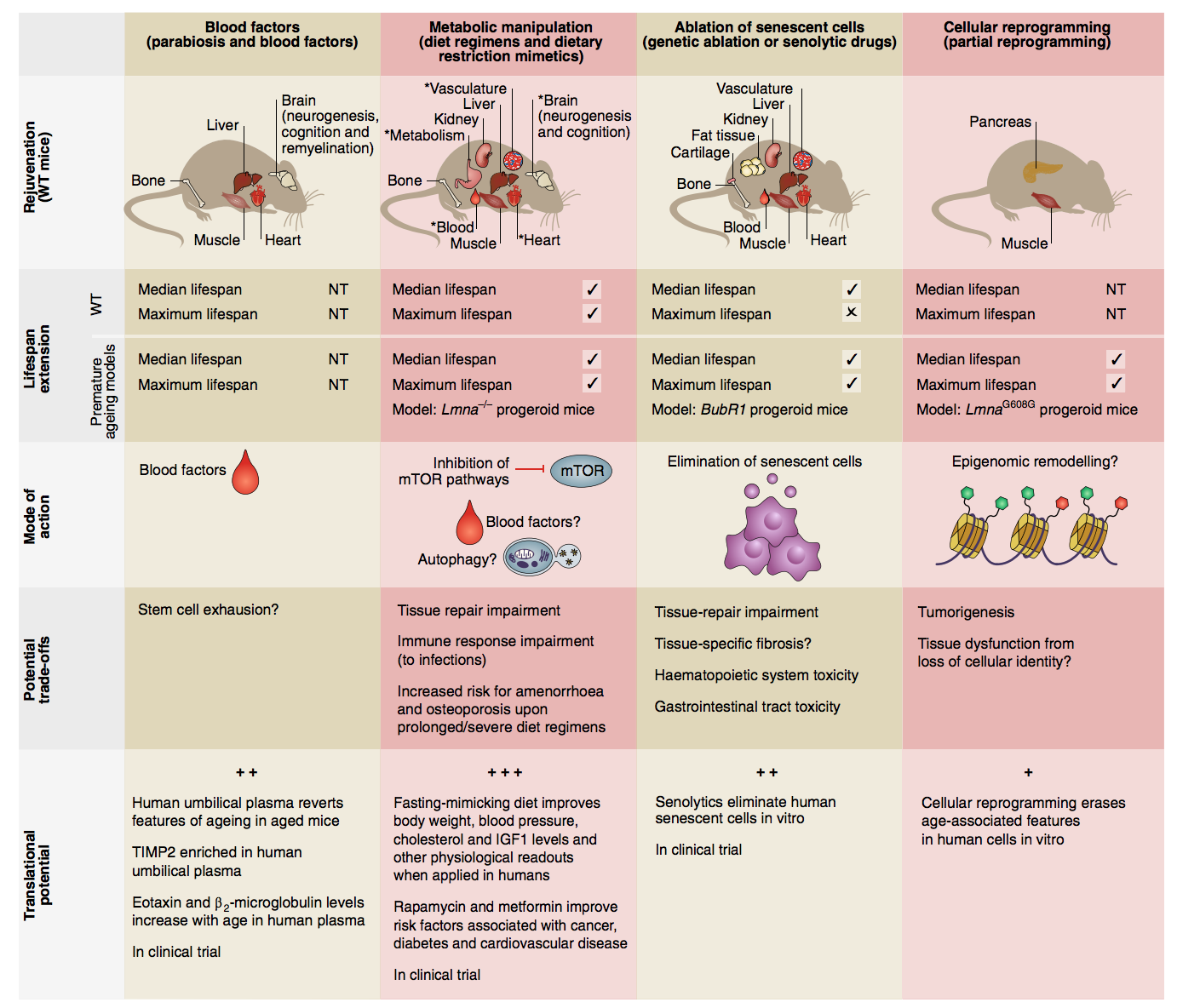
From a review of emerging rejuvenation strategies from Anne Brunet’s lab, we have a summary figure:

Reproduced from: Mahmoudi S, Xu L, Brunet A. Turning back time with emerging rejuvenation strategies. Nature cell biology. 2019 Jan;21(1):32-43.

In addition, I would add a few other directions:

  • Thymic regeneration: the TRIIM (Thymus Regeneration, Immunorestoration, and Insulin Mitigation) study resulted in a variety of beneficial biomarker indicators for epigenetic age reversal and immune function restoration. Greg Fahy gave an excellent talk on this. Combinations of thymus transplants and hematopoietic stem cell transplants can yield profound system-wide effects. (Another company has recently emerged focusing on thymic restoration via FOXN1.)
  • Advances in understanding immunosenescence generally, and its coupling to other aspects of aging: e.g., CD38 on the surface of monocytes may be responsible for aberrantly clearing NAD+, which then couples to more traditionally understood metabolic changes in aging — see this excellent summary of the field
  • Brain based neuroendocrine control: IKKβ, in the microglial cells in the medial basal hypothalamus in the brain seems to control multiple aspects of aging, and aging genes FOXO1 and DAF-16 seem to be at least in part under the control of neural excitation
  • Combinatorial gene therapies: We will discuss the need for this extensively below. In at least one paper, the authors focused on non cell autonomous genes which could drive systemic changes: fibroblast growth factor 21 [FGF21], αKlotho, soluble form of mouse transforming growth factor-β receptor 2 [sTGFβR2], showing they could ameliorate obesity, type II diabetes, heart failure, and renal failure simultaneously (the effect seems mostly due to FGF21 alone) 
  • Enhancing mitochondrial function: activating the expression of peroxisome proliferator activated receptor gamma coactivator-1α (PGC-1α) and mitochondrial transcription factor A (TFAM) to enhance mitochondrial biogenesis and quality control. T cells deficient in TFAM induce a multi-systemic aging phenotype in mice.
  • Novel metabolic targets: e.g., J147, targeting ATP synthase, may not be redundant with mTOR inhibition and thus could be used combinatorially: “J147 reduced cognitive deficits in old SAMP8 mice, while restoring multiple molecular markers associated with human AD, vascular pathology, impaired synaptic function, and inflammation to those approaching the young phenotype”.

“Epigenetic clock” biomarkers, reviewed here, and recent proteomic clocks, are another key advance from the past few years. In theory, clocks like these could serve as surrogate endpoints for trials, greatly accelerating clinical studies, but there are issues to be solved (see below).

Major problems holding back the field today

Still, there are a set of related, self-reinforcing factors that likely dramatically slow progress in the field:

  1. Studies are often bespoke and low-N, focus on single hypotheses, and only measure a small subset of the phenotype
    • I believe that the aging field suffers from fragmented incentives, with many small academic groups competing with one another while needing to differentiate themselves individually — this limits the scope for replication studies, combination studies and systemic convergence
    • In the absence of robust pharmaceutical industry interest in supporting the entire pipeline for anti-aging, including at early stages, the more ambitious studies (e.g., bloodborne factors or blood plasma dilution, epigenetic reprogramming) are being done by academic labs with limited resources, and are therefore carried out by postdocs with incentives focused around academic credit-assignment, i.e., limited incentives for large-scale system-building beyond publishing individual papers.
      • For example, the potentially revolutionary recent Conboy lab result that an already-FDA-approved blood plasma dilution procedure ameliorates multi-systemic aging in mice only used N=4 mice for most of its measurements. For such an important-if-true result, this seems absurdly under-powered! Indeed, they apparently replaced the entire first figure of the paper with a post-hoc justification as to why N=4 would give sufficient statistical power, probably in response to critical peer reviewers, instead of simply running more mice. This smells to me like “problematic local academic incentives”, and possibly symptomatic of under-funding as well. See here for more discussion. 
      • Likewise, the finding of GDF11 as a bloodborne rejuvenative factor has had trouble with replication. That’s the nature of science but it seems prevalent in the aging field. 
      • Another recent result on bloodborne factors was published with fanfare but had N=6 rats, did not list what their factors actually were, did not list complete methods, and was led by a small unknown company in India — see here for a discussion of some of the problematic aspects in the publication of what otherwise would be a clear win. This study relied heavily on epigenetic clocks. 
      • The TRIIM (Thymus Regeneration, Immunorestoration, and Insulin Mitigation) study result, which looks preliminarily very compelling, was done with only N=9 human subjects, and was conducted by brilliant but “off-the-beaten path researchers”, working at a small startup (Intervene Immune, Inc) taking donations via its website. This study also relied heavily on epigenetic clocks to argue its anti-aging effect.
      • The NIH Interventions Testing program (ITP) at the National Institute on Aging (NIA) specifically exists to replicate and independently test aging drugs, but has apparently not extended beyond studies of single small molecules to my knowledge or addressed the most cutting edge rejuvenation therapies, let alone combinations thereof.
  1. Tools and tool access/utilization are still limited compared to what they could be
    • As in many biological fields, key bottlenecks could be accelerated via targeted engineering advances, but tools companies and tool development projects generally remain under-funded relative to potential impact
      • For example, for bloodborne factors, we might benefit from a tool that can very precisely add or remove many specific user-defined factors from circulation, but the field has primarily focused on much simpler interventions, beginning with simply suturing young and old animals together (which raised the confound that the young animal’s organs can filter the old blood, not just provide circulating factors)
      • For epigenetic clocks, the technology is still based on methylation arrays, rather than next-generation sequencing based assays which could be multiplexed/pooled to optimize sequencing cost and could then be made much cheaper and thus applied at much larger scale (see below for details)
      • For proteomic measurements, these mostly still use defined sets of a few thousand targets, e.g., assayed using SomaLogic aptamer arrays, rather than next-generation unbiased technologies like improved mass spec proteomics (Parag Mallick et al), single cell proteomics (see recent major advances from e.g. Nikolai Slavov’s lab at Northeastern, which are currently operating at very acute sub-scale and have not been industrialized at all), let alone emerging single-molecule protein sequencing (see many new companies in this area such as QuantumSi and Encodia and recent work from Edward Marcotte’s lab now part of the company Erisyon). Aptamer array based methods may be missing, for example, small peptides like the promising mitochondrial-derived peptide humanin.
      • For epigenetic measurements and proteomic measurements, these are mostly not done at single-cell level, limiting our understanding of the specific cell types that contribute causally — for instance, if aging is heavily due to exhaustion of specific adult stem cell populations, we might find that these stem cell populations are the primary locus of the epigenetic changes, but discovering this requires single cell measurement (or else cumbersome cell type specific bulk isolation procedures)
      • Epigenetic measurements mostly haven’t taken into account the latest technologies for measuring chromatin accessibility directly, such as ATAC-seq (short for Assay for Transposase-Accessible Chromatin using sequencing) or combined single-cell ATAC-seq and RNAseq
      • Measurements of epigenetic effects do not yet include the most advanced in-situ epigenomics measurement technologies that operate by imaging in the context of intact tissues, e.g., FISSEQ, MERFISH, ExSEQ
  1. There is limited infrastructure and incentive for combinatorial studies
    • There appears to be a market failure around combinatorial testing of interventions
    • Combinatorial interventions seem warranted for several reasons, including:
      • aging may be fundamentally multi-factorial 
      • there may be synergies between mechanisms that can create self-reinforcing positive feedback loops in regeneration 
      • using many mechanisms in combination may allow each to be used at lower dosage and thus avoid side effects by avoiding driving any one pathway too strongly 
      • there may be scientific value in understanding the combinations that turn out to be useful, e.g., for identifying overlapping underlying factors and common effects behind diverse superficially-different sets of interventions 
    • For the most part, academic labs are not incentivized to systematically pursue combination therapies. This is because they focus on proving out the specific hypotheses that each lab specializes in and depends on for its reputation, often focusing on telling simple stories about mechanisms. For example, while there are labs that specialize in senescent cell clearance or bloodborne factors, it is hard to differentiate oneself academically while having a lab that combines both or is hypothesis agnostic. (Technology/tools focused labs may be better for this but then may lack the long-term follow-through to make the scientific discoveries in this field or to operate large in-vivo studies.)
      • It is also simply a lot of work to build up enough expertise in multiple domains to properly combine interventions and measurements, and this may put combination studies beyond the scale of most academic projects, even if well funded, which involve only 1-3 first-author grad students and postdocs playing primary driving roles due to the needs of academic credit assignment.
      • Tools in the field are also not optimized for combination studies, e.g., one may have one transgenic mouse model for dealing with senescent cell experiments, and another for epigenetic reprogramming experiments, and these may not be compatible or easy to fuse. (Using appropriate viral methods could overcome this but depends on good delivery vectors, and so forth.)
      • This is not to mention the fact that combination studies will inherently require a larger number of subjects N to gather appropriate statistics, which as mentioned above seems to be hard for academic labs to achieve.
    • Meanwhile, biotech and pharma are also not incentivized to do combinatorial studies
      • This is because pharma companies make money off of readily-translatable drugs, mostly small molecule drugs. Combinations would be harder to get approval for, especially if they involve new modalities like epigenetic reprogramming that may require more far-off inducible gene therapies, or unusual methods like blood dilution or combinations of multiple antibodies to block multiple age-associated targets. To make a simple and robust business case with a well-defined risk calculation, a pharma company wants simple single-target small molecule drugs, and that is simply not what the aging field, at its current level of development and possibly ever, requires to make progress.  
    • This leaves a gap where no organizations are seriously pursuing large-scale combination studies, to my knowledge, neither in humans or animals, and neither for advanced interventions like epigenetic reprogramming nor for simple lifestyle interventions, despite proposals
  1. Biomarkers are not yet established to be causal, as opposed to correlative
    • Epigenetic aging clocks and/or proteomic aging clocks would, in principle, show promise as primary endpoints for pre-clinical or clinical studies. Rather than waiting years to see extension of a mouse or human’s health-span, one could in a matter of weeks or months measure changes to epigenetic or proteomic clocks that are predictive of their ultimate healthspan. 
    • Yet the field of aging biomarkers still has major problems that limit this possibility at a technical level.
    • Specifically, it is not yet known to what degree epigenetic or proteomic aging signatures are causal of aging, versus correlative. (There are some statistical reasons to worry they may not be causal, although probably this particular reasoning applies mostly to first gen studies that relied on patchy cross-sectional datasets like the Horvath multi-tissue clock; if one uses cohorts then one gets better predictors, which is part of why GrimAge and PhenoAge work so well for mortality.) This poses several problems:
      • If they are only correlative, then there may be ways that putative therapies could “turn back the clocks”, but without affecting aging itself, i.e., they would only treat surface level indicators and thus be misleading
      • In the worst case, the epigenetic and proteomic changes could represent compensations in the body acting against aging or to forestall aging. In that case, turning back the clocks might actually accelerate aging! 
    • Additionally, for epigenetic reprogramming therapies that probably operate at least in part through DNA methylation changes (and thus are visible in epigenetic clocks), the full set of damage types they reverse is not yet established. To my knowledge (and also Laura Deming’s), for example, nobody has measured whether the epigenetic reprogramming procedures used by Ocampo et al or the Sinclair lab will reduce the age-dependent buildup of lipofuscin aggregates in cells (whereas rapamycin seems to in some studies, as well as centrophenoxine). Likewise it would be nice to look at the shape/integrity of the nuclear lamina, and whether epigenetic changes repair this as well. There are probably many other examples of this sort.
    • Finally, controversy about epigenetic clocks limits their adoption, so many studies coming out in different parts the aging field don’t measure this even though it would be easy to, e.g., the recent Conboy blood results don’t include an epigenetic clock measurement
    • See here for a table of current putative limitations of epigenetic clocks.
  1. Aging itself is not yet established as a disease or as an endpoint for clinical trials, and this may exacerbate the systemic market failures that plague preventative medicine
    • Since underlying aging factors likely cause many diseases in a multi-systemic fashion (e.g., systemic inflammation and circulatory damage may mediate both Alzheimer’s susceptibility and many other problems, e.g., cardiovascular, renal), and since these factors would best be dealt with preventatively, it would be ideal if aging itself could be classified as a disease, and even more ideal if changes in a predictive biomarker of aging could be used as an endpoint for trials
    • Many aging researchers made this same point recently in an essay in Science.
    • Yet the government is not moving on this issue, to my knowledge.

How to accelerate progress

I see four categories of systemic intervention here, all of which could be done under the umbrella of a coordinated ARPA-style initiative, at a scale of multiple tens of millions of dollars, that would cut across multiple sectors:

  • Build and/or fund non-academic Focused Research Organizations, that would carry out large-N, combinatorial screens while assaying as many phenotypic features as possible
    • We can choose to view the problem from an engineering lens: as a “search” and “measurement” problem. Viewed from this lens, we should build a dedicated, appropriately-scaled, incentive-aligned, well-managed organization to carry out the required scalable assays and search procedures — or potentially create the impetus via milestone-based funding to pivot an existing organization to focus heavily on this (possibilities for existing organizations to re-focus on this could perhaps include aging gene therapy startups like Rejuvenate Bio, Gordian Biotechnologies, a biology experiment platform company like Strateos or Vium, or potentially an organization like the Buck Institute, could partially re-structure or expand to focus on this, or perhaps some partnership of such — there also appears to be at least one aging focused CRO).
    • The purpose of such an organization could be: Searching the combinatorial space of aging interventions, while assaying the combinatorial space of aging phenotypes
    • While many individual aging mechanisms and their associated biology control knobs are being discovered in a piecemeal fashion, we do not yet have a way to comprehensively rejuvenate mammals or extend their lifespans.  Achieving this likely requires not just turning one knob at a time but turning multiple independent and interacting knobs in the correct pattern. This leads to a large combinatorial search space, but to our knowledge no organization has yet tried to search it except on the smallest of scales, probably due to the mismatch of this problem with both short term corporate (low-risk single-drug-at-a-time development) and individual-academic-lab (competitive differentiation and credibility) incentives.

More on the combinatorial intervention aspect:

  • Rather than immediately shooting for a single mechanism (what an academic would mostly be incentivized to do) or a single blockbuster drug molecule (what a company would mostly be incentivized to do), we need to first find some set of sufficient conditions for modulating healthspan by large “leaps” in the first place
  • We need a systematic project to apply factorial design to screen combination therapies across many mechanistic classes, in order to get a hit on at least one combined set of perturbations to mammalian organismal biology that can boost healthspan and regenerate many tissues without side effects. 
  • Even in a mouse, I think one could argue that this would revolutionize prospects in aging research and allow efforts to then be focused on more promising pathways — we would know at least one approach that works towards the end goal of broad healthspan extension, and the question would be translating it to a viable therapy, not whether it is fundamentally possible to slow, stop or reverse aging in a complex long-lived mammal. 
  • The “search process” could focus on simple endpoints like lifespan and serum-derived biomarkers, but alternatively, and preferably, it could comprehensively measure multi-system impacts (e.g., on all 9 “hallmarks of aging”) of interventions using multi-omics assays, and dynamically adapt the interventions accordingly, while building up a digital mapping between a multi-dimensional space of interventions and a multi-dimensional space of phenotypic effects.
    • On the assay side, this could utilize, and in the process push forward, new technologies for scanning 3D biomolecular matter in a very general and precise way (e.g., combinations of FISSEQ, MERFISH, Expansion Microscopy, multiplexed antibody staining with DNA or isotope barcoded antibodies), where one can localize and identify many different molecules per specimen at high 3D spatial resolution and over large volumes of tissue, e.g., mapping the locations and identities of hundreds to thousands of disease-relevant proteins and RNAs throughout intact specimens at nanoscale resolution. The core chemistries and imaging technologies for this exist, but they need to be integrated and brought to scale. 
      • At this level of detail, we could ask questions like: How does the loss of synapse integrity in the aging brain, say, relate to the disruption of gene expression patterns in particular parts of the tissue, subcellular damage such as holes in the nuclear membranes inside cells or buildup of lipofuscin “junk”, changes to blood brain barrier integrity, or altered surveillance by the immune system? Rather than measuring these sparsely and separately, we could measure them comprehensively and integratively inside the same intact specimen.
  • A more advanced version of the combinatorial intervention approach might use highly multiplexed CRISPR activation/inactivation of genes using libraries of CRISPR gRNAs and transgenic animals that already express the CRISPR machinery itself. Already, people are doing dozens of CRISPR sites per cell in other contexts, and reading out results based on whole-transcriptome RNAseq. This could be done first at a cellular level in a dish, and then at an organismal level using appropriate systemic gene delivery vectors, e.g., optimized blood brain barrier crossing AAVs or similar. See our review on in-vivo pooled screening for aging.
  • Note that the company Rejuvenate Bio was founded on the basis of this PNAS paper on a combinatorial gene therapy approach in animals (3 non-cell-autonomous genes with individually known effects), but it appears that its go-to-market strategy is based on a fixed combination of just two of those gene therapy targets in dogs with a congenital cardiovascular disease. It is unclear to me if it is planning to do large scale screening of novel combinations or to target aging itself in the near term. Startups often need to take the shortest path to revenue.
  • Outside of animal models, a program could also strongly pursue combinations of, e.g., already-FDA-approved compounds in human studies. Intervene Immune’s and Steve Horvath’s work with the TRIIM study is suggestive (but could be massively scaled, expanded and better outfitted), as is the TAME metformin trial. This would synergize nicely with a focused effort to improve epigenetic clock and other aging biomarkers, e.g.,  the Immune Risk Profile. Indeed, arguably an entire program could focus on human studies of systemic anti-aging / rejuvenation interventions that would fall short of a completely general approach to aging, e.g., combination therapies for immune system rejuvenation in the elderly
  1. Fund an ARPA-style initiative to develop new tools for measurement and highly specific perturbation of aging phenotypes
    • One notable low-hanging-fruit opportunity here is to lower the cost of genome-wide epigenetic clock measurements by 10x, while increasing their depth of mechanistic access
      • Epigenetic clocks currently use methylation arrays, costing around $400 per sample. This limits the size of study that can be done, e.g., to do a 100k-1M people, or 1-10k people or animals with 30 tissue types per sample and 3 time points, would be cost-prohibitive here even for the largest organizations. 
      • The emergence of next-generation sequencing based methods for DNA methylation measurement (e.g., TAPS) would allow reduction to $10 per sample, via DNA-sequence-tag-based multiplexing of many samples into a single sequencing run, a 40x cost reduction
        • Note that this could have major spinoff application to areas like liquid biopsy for cancer detection, some of which already rely on circulating tumor DNA (ctDNA) methylation, and wherein, because cancer incidence is low, very large N studies are needed to test for the statistical significance of an early detection method
        • New epigenetic and proteomic profiling tools would also have major application to patient stratification or novel primary endpoints for clinical trials of diverse diseases
      • One could also fund this to be applied at the single-cell level (definitely possible — see these papers) and in combination with recent methods for single-cell chromatin accessibility, single-cell RNAseq, single-cell chromatin conformation capture, or scRNAseq + CyTOF to measure both RNA and proteins at single-cell resolution. This would be likely to get to a far more mechanistic level of description than bulk methylation based epigenetic clocks. (An interesting form of clock indeed would be one that measured mismatches between DNA methylation, RNA and protein levels.)
    • Next generation clocks based on proteomics, mtDNA, or exosomes could be powerful
      • One could also invest in next generation proteomic profiling that goes beyond the SomaLogic targeted aptamer panels (on the order of a couple of thousand proteins assayed, out of 23k protein-coding genes in the genome not to mention many variants) to profile many more proteins or in a more unbiased way, and/or catalyze the use of such emerging technologies by the aging field by stimulating/funding collaborations with emerging companies in the proteomics field
      • Mitochondrial DNA profiling could be relevant as well, e.g.,  single cell mitochondrial genome sequencing
      • We could fund entirely new, and possibly even more powerful, methods of profiling aging, e.g., exosomal vesicles appear to provide a noninvasive transcriptome measure that could be applied in humans with a blood draw and methods are emerging for cell type specific exosome extraction, which could in theory perhaps get us a tissue-type or cell-type specific epigenetic clock using sampling of exosomal vesicles in circulation via sequencing.
    • We could develop improved and more accessible ways to measure key aging-related metabolites like NAD (i.e., specific small molecules)
    • We could stimulate the maturation and application to aging of in-situ spatially resolved epigenomics methods
    • On the precise perturbation side, we could look into the state of the technology for multiplex targeted removal of specific factors from blood. This could also use a combinatorial approach, e.g., with combinations of inactivating aptamers or antibodies, either delivered to the animal or used as capture arrays for a blood filtration device. This could allow casual examination of the significance of potential detrimental factors found in aged blood plasma. We could also invest in other improved tools for tracking the causal influence of specific blood factors on aging in downstream tissues. 
    • We could also ensure that appropriate in-vivo multiplex CRISPR activation and inactivation technologies are available to meet the needs of the aging field. 
  1. Fund an ARPA-style initiative to create validated, causal epigenetic, proteomic, scRNAseq, exosomal or combined “clocks” and apply them to large existing banks of samples
    1. For epigenetic clocks, this could include:
      • Single-cell studies to determine whether epigenetic clocks (in various tissues) reflect large changes to a sub-population of cells (e.g., adult stem cells), versus small changes to many types of cells indiscriminately, versus changes in the cell type composition of the tissue without changes to any individual cell type  — this could help to establish the causal mechanisms, if any. From a recent paper: “DNA methylation-based age predictors are built with data from bulk tissues that represent a mix of different cell types. It is plausible that small changes in cell composition during ageing could affect the epigenetic age of a tissue. Stem cells, which generally decrease in number during ageing, might be one of these cell populations. Consequently, the epigenetic clock might be a measure of the different proportions of stem and differentiated cells in a tissue.” If true, this could provide an impetus to target epigenetic reprogramming efforts specifically toward ameliorating stem cell exhaustion.
      • More generally, we can try to measure the mechanisms driving epigenetic clock “progression” over aging
      • Decoupling damage from aging, e.g., understand what is unique about aging as opposed to other kinds of damage to cells, and that can be uniquely tracked by next-gen “clocks”. Cells can be exposed to various specific kinds of damage and repair to see the impact on the clocks, as opposed to the impact of aging as such, and clocks can be “focused” to specifically measure aging itself.
      • Fund measurements determine whether epigenetic reprogramming therapies (e.g., pulsed OSK(M) as in Ocampo et al 2016) also restore other types of cellular damage beyond epigenetic states per se, e.g., buildup of lipofuscin, or decrease in proteo-stasis, and determine whether improved biomarkers can be devised that track all of these aspects as opposed to merely epigenetics
      • Applying the resulting new, richer, cheaper biomarkers to existing bio-banks, including those that tracked people over long timescales and recorded their ages and causes of mortality, and releasing the resulting data in a machine-learning-accessible way such that anyone can train new predictive models on these data
        • Existing cohorts (e.g., mentioned in Wyss-Coray papers) include the INTERVAL study, the SG90 Longevity Cohort study, the Einstein Aging Study cohort, Lothian Birth Cohorts (LBCs) of 1921 and 1936, the Whitehall study, Baltimore Longitudinal Study of Aging (BLSA), and probably many others.
        • We would want to make all the data easily accessible in a universal database so lots of people with expertise in machine learning around the world could extract new kinds of predictors from it
      • Developing proteomic or epigenetic profiles that are targeted to more specific known effects, like they recently did for senescence associated secretory phenotype (SASP) but much more broadly and aggressively. Other profiles could include a set of human homologues of Naked Mole Rat proteins thought to be involved in their aging resistance.
  1. Educate and incentivize the government to take appropriate actions
    • Lobby the FDA to classify organismal senescence itself as a disease
      • Perhaps this needs to be done by first educating members of Congress, Tom Kalil suggests
      • Recent though partial progress has occurred with the TAME metformin trial, which had languished for years but recently appears to have accelerated due to a $40M infusion of private funding: “Instead of following a traditional structure given to FDA approved trials (that look for a single disease endpoint) TAME has a composite primary endpoint – of stroke, heart failure, dementia, myocardial infarction, cancer, and death. Rather than attempting to cure one endpoint, it will look to delay the onset of any endpoint, extending the years in which subjects remain in good health – their healthspan.” It may be possible to replicate this trial design for future studies. 
    • Push for more aging-related biomarker endpoints in clinical trials of all sorts of drugs
    • Lobby for expansion of the NIH Interventions Testing Program (ITP) for aging drugs, or perhaps for NIA to fund external such programs — including going to more complex treatments beyond small molecules, and replicating key aging studies at large N
    • Create funding-tied incentives for larger-N and replicated studies in the aging field, as well as for certain phenotypic measurements to become common and released openly for all funded studies

Acknowledgements: 

Thanks to Sarah Constantin, Laura Deming and Sam Rodriques for helpful discussions prior to the writing of this document.

Notes: Some climate tech companies & projects

(as a non-expert, circa early 2021)

See also my notes from 2018 on climate:
https://johncarlosbaez.wordpress.com/2019/10/05/climate-technology-primer-part-1/
https://johncarlosbaez.wordpress.com/2019/10/13/climate-technology-primer-part-2/
https://longitudinal.blog/co2-series-part-3-other-interventions/

Cement/concrete —
https://www.engine.xyz/founders/sublime-systems/
https://www.solidiatech.com/

Batteries —
http://www.a123systems.com/
https://ionicmaterials.com/
https://formenergy.com/technology/battery-technology/

Cheap green hydrogen production by electrolysis, useful for grid scale storage —
https://www.crunchbase.com/organization/origen-hydrogen
https://hydroxholdings.co.za/technology/

Thermal energy storage, for grid-scale storage —
https://www.antoraenergy.com/technology
See also:
https://escholarship.org/content/qt2vz9b61f/qt2vz9b61f.pdf
https://arxiv.org/abs/2106.07624
https://www.science.org/doi/abs/10.1126/science.1218761

Food with less animals and ultimately less agriculture overall —
https://impossiblefoods.com
https://www.calysta.com/ (animal feed from methane)
https://www.activate.org/circe-bioscience (food from water and CO2)
See: https://www.nature.com/articles/s41587-020-0485-4
https://www.washingtonpost.com/archive/lifestyle/food/1984/05/27/can-food-be-made-from-coal/d80567ac-c656-4e0b-9f54-d505bd6d261a/
https://www.pnas.org/content/117/32/19131

Fusion —
Z-pinch and other magneto-inertial methods
https://www.zapenergyinc.com/
https://www.helionenergy.com/
Commonwealth Fusion and Tokamak Energy also

Compact and safer nuclear fission —
https://oklo.com/ (minimalist approach) https://twitter.com/oklo?lang=en
https://www.nuscalepower.com/
https://www.terrapower.com/
https://thorconpower.com/

Geothermal anywhere drilling —
https://www.engine.xyz/founders/quaise/
https://www.texasgeo.org/
https://pangea.stanford.edu/ERE/db/GeoConf/papers/SGW/2021/Malek.pdf (analysis of closed loop)

Solid state heat to electricity conversion —
https://modernelectron.com/

Electrofuels —
https://infiniumco.com/
https://carbonengineering.com/

Other carbon utilization —
https://www.twelve.co/
https://www.lanzatech.com/

Improved air conditioning and refrigeration with low global-warming potential —
https://www.gradientcomfort.com/
https://www.rebound-tech.com/

Substituting for nitrogen fertilizers —
https://www.pivotbio.com/

Marine cloud brightening —
https://www.nature.com/articles/d41586-021-02290-3 (Australia)
https://www.silverlining.ngo/research-efforts (analysis)

Soil carbon measurement —
https://arpa-e.energy.gov/technologies/programs/roots

Electro-swing direct air capture —
https://www.crunchbase.com/organization/verdox

Far out ideas to locally divert hurricanes —
https://viento.ai/

Philanthropic/patient capital for climate ventures with PRIs —
https://primecoalition.org/what-is-prime/

Novel approaches to enhance natural ocean carbon drawdown —
https://faculty-directory.dartmouth.edu/mukul-sharma (clay minerals)
https://www.frontiersin.org/articles/10.3389/fmars.2019.00022/full

Advance market commitments for negative emissions and other problems —
https://stripe.com/sessions/2021/building-carbon-removal
https://www.gavi.org/vaccineswork/what-advance-market-commitment-and-how-could-it-help-beat-covid-19
https://www.nuclearinnovationalliance.org/search-spacex-nuclear-energy

Kelp farming, ocean utilization, biochar and other multidisciplinary problems —
https://www.climatefoundation.org/

Managing wildfires —
https://nintil.com/managing-wildfires

Crops —
https://x.company/projects/mineral/

Desalination —
https://www.tridentdesal.com/
https://www.energy.gov/eere/solar/american-made-challenges-solar-desalination-prize

Getting more science-based companies to happen in this space —
https://www.activate.org/mission

Enhanced weathering for negative emissions —
https://www.projectvesta.org/

AI and data —
https://www.annualreviews.org/doi/abs/10.1146/annurev-nucl-101918-023708
https://www.climatechange.ai/

Venture portfolios —
https://www.breakthroughenergy.org/
https://lowercarboncapital.com/
https://www.engine.xyz/

ARPA-E

“Reframing Superintelligence” is a must-read

Eric Drexler of Oxford’s Future of Humanity Institute has published a new book called Reframing Superintelligence: Comprehensive AI Services as General Intelligence.

The book’s basic thesis is that the discussion around super-intelligence to date has suffered from implicit and poorly justified background assumptions — particularly the idea that advanced AGI systems would necessarily take the form of “rational utility-directed agents”.

Drexler argues a number of key points, including:

–One can, in principle, achieve super-intelligent and highly general and programmable sets of services useful to humans, which embody broad knowledge about the real world, without creating such rational utility-directed agents, thus sidestepping the problem of “agent alignment” and leaving humans in full control.

–A sketch of architectural principles for how to do so, through an abstract systems model Drexler terms Comprehensive AI Services (CAIS)

–The need to clarify key distinctions between concepts, such as reinforcement learning based training versus the construction of “reward seeking” agents, which are sometimes conflated

–A set of safety-related concerns that Drexler claims are pressing and do need attention, within the proposed framework

In addition, Drexler provides a fun conceptual synthesis of modern AI, including a chapter on “How do neural and symbolic technologies mesh?” which touches on many of the concerns raised by Gary Marcus in his essay on “Why robot brains need symbols“.

I will be keen to see whether any coherent and lucid counter-arguments emerge.

Update: a couple of nice blog posts have appeared on this topic from Richard Ngo and from Rohin Shah.

On whole-mammalian-brain connectomics

In response to David Markowitz’s questions on Twitter:
https://twitter.com/neurowitz/status/1080131620361912320

1. What are current obstacles to generating a connectomic map of a whole mammalian brain at nanometer scale?
2. What impt questions could we answer with n=1? n=2?
3. What new analysis capabilities would be needed to make sense of whole brain data?

Responses:

David himself knows much or all of the below, as he supported a lot of the relevant work through the IARPA MICRONS program (thank you), and I have discussed these ideas with many key people for some years now, but I will go into some detail here for those not following this area closely and for the purposes of concreteness.

1) What are current obstacles to generating a connectomic map of a whole mammalian brain at nanometer scale?

I believe the main obstacles are in “getting organized” for a project of this scale, not a fundamental technical limitation, although it would make sense to start such a project in a few years after the enabling chemistry and genetic advances have a bit more time to mature and to be well tested at much smaller scales.

a) Technical approaches

As far as technical obstacles, I will not address the case of electron microscopy where I am not an expert. I will also not address a pure DNA sequencing approach (as first laid out in Zador’s 2012 Sequencing the Connectome). Instead, I will focus solely on optical in-situ approaches (which are evolutionary descendants of BrainBow and Sequencing the Connectome approaches):

Note: By “at nanometer scale”, I assume you are not insisting upon literally all voxels being few nanometer cubes, but instead that this is a functional requirement, e.g., ability to identify a large fraction of synapses and associate them with their parent cells, ability to stain for nanoscale structures such as gap junctions, and so forth. Otherwise an optical approach with say > 20 nm spatial resolution is ruled out by definition — but I think the spirit of the question is more functional.

There are multiple in-situ fluorescent neuronal barcoding technologies that, in conjunction with expansion microscopy (ExM), and with optimization and integration, will enable whole mammalian brain connectomics.

We are really talking about connectomics++: It could optionally include molecular annotations, such as in-situ transcriptome profiling of all the cells, as well some multiplexed mapping of ion channel protein distributions and synaptic sub-types/protein compositions. This would be an added advantage of optical approaches, although some of these benefits could conceivably be incorporated in an electron microscopy approach through integration with methods like Array Tomography.

For the sake of illustration, the Rosetta Brain whitepaper laid out one potential approach, which uses targeted in-situ sequencing of Zador barcodes (similar to those used in MAPseq) both at cell somas/nuclei and on both sides of the synaptic cleft, where the barcodes would be localized by being dragged there via trafficking of RNA binding proteins fused to synaptic proteins. This would be a form of FISSEQ-based “synaptic BrainBow” (a concept first articulated by Yuyiy Mischenko) and would not require a direct physical linkage of the pre- and post-synaptic barcodes — see the whitepaper for explanations of what this means.

The early Rosetta Brain white-paper sketch proposed to do connectomics via this approach using a combination of

a) high-resolution optical microscopy,

b) maximally tight targeting of the RNA barcodes to the synapse,

&

c) “restriction of the FISSEQ biochemistry to the synapse”, to prevent confusion of synaptic barcodes with those in passing fine axonal or dendritic processes.

This is now all made much easier with Expansion Microscopy, which is now demonstrated at cortical column scale,  although this was not yet the case back in 2014 when we were initially looking at this (update: expansion lattice light sheet microscopy is on the cover of the journal Science and looks really good).

(Because ExM was not around yet, circa 2014, we proposed complicated tissue thin-sectioning and structured illumination schemes to get the necessary resolution, as well as various other “molecular stratification” and super-resolution schemes, which are now unnecessary as ExM enables the requisite resolution using conventional microscopes in intact, transparent 3D tissue, requiring only many-micron-scale thick slicing.)

(This approach does rely quite heavily on synaptic targeting of the barcodes; whether the “restriction of FISSEQ biochemistry to the synapse” is required depends on the details of the barcode abundance and trafficking, as well as the exact spatial resolution used, and is beyond the scope of the discussion here.)

With a further boost in resolution, using higher levels of ExM expansion (e.g., iterated ExM can go above 20x linear expansion), and in combination with a fluorescent membrane stain, or alternatively using generalized BrainBow-like multiplexed protein labeling approaches alone or in combination with Zador barcodes, the requirement for synaptic barcode targeting and restriction of FISSEQ biochemistry to the synapse could likely be relaxed, and indeed it may be possible to do it without any preferential localization of barcodes at synapses in the first place, e.g., with membrane localized barcodes, an idea which we computationally study here:
https://www.frontiersin.org/articles/10.3389/fncom.2017.00097/full

In the past few years, we have integrated the necessary FISSEQ, barcoding and expansion microscopy chemistries — see the last image in
https://spectrum.ieee.org/biomedical/imaging/ai-designers-find-inspiration-in-rat-brains
for a very early prototype example — and ongoing improvements are being made to the synaptic targeting of the RNA barcodes (which MAPseq already shows can traffic far down axons at some reasonable though not ideal efficiency), and to many other aspects of the chemistry.

Moreover, many other in-situ multiplexing and high-resolution intact-tissue imaging primitives have been demonstrated with ExM that would broadly enable this kind of program, with further major advances expected over the coming few years from a variety of groups.

At this point, I fully believe that ExM plus combinatorial molecular barcoding can, in the very near term, enable at minimum a full mammalian brain single cell resolution projection map with morphological & molecular annotations, and with sparse synaptic connectivity information — and that such an approach can, with optimization, likely be engineered to get a large fraction of all synapses (plus labeling gap junctions with appropriate antibodies or other tags).

This is not to downplay the amount of work still to be done, and the need for incremental validation and improvement of these techniques, which are still far less mature than electron microscopy as an actual connectomics method. But it is to say that many of the potential fundamental obstacles that could have turned out to stand in the way of an optical connectomics approach — e.g., if FISSEQ-like multiplexing technologies could not work in intact tissue, or if optical microscopy at appropriate spatial resolution in intact tissue was unavailable or would necessitate difficult ultra-thin sectioning, or if barcodes could not be expressed in high numbers or could not traffic down the axon — have instead turned out to be non-problems or at least tractable. So with a ton of work, I believe a bright future lies ahead for these methods, with the implication that whole-brain scale molecularly annotated connectomics is likely to become feasible within the planning horizon of many of the groups that care about advancing neuroscience.

b) Cost

In the Rosetta Brain whitepaper sketch, we estimated a cost of about $20M over about 3 years for this kind of RNA-barcoded synaptic BrainBow optical in-situ approach, for a whole mouse brain.

Although this is a very particular approach, and may not be the exact “right” one, going through this kind of cost calculation for a concrete example can still be useful to get an order-of-magnitude sense of what is involved in an optical in-situ approach:

If we wish to image with 4.5x expansion, that’s about 1 mm^3 / ((300 x 300 x 300 nm^3)/4.5^3) = 3e12 voxels
(The spatial resolution there is about 300/4.5 = 67 nm.) (Note that we’ve assumed isotropic resolution, which can be attained and even exceeded with a variety of practical microscope designs.)

For FISSEQ-based RNA barcode connectomics, we want say 4 colors in parallel (for the A, T, C and G bases of RNA), with 4 cameras, and to image say 20 successive cycles of that or on the order of 4^15 = 1B unique cell labels (assuming there is some error rate and/or near but not complete base-level diversification of the barcode such that we get a diversity corresponding to, say, 15 bases after sequencing 20).

The imaging takes much longer than the fluidic handling (which is highly parallel) as sample volumes get big, so let’s focus on considering the imaging time:

We have ~3e12 voxels * 20 cycles, so 6e13 voxels total, and let’s suppose that we have a camera that operates at a frame rate of ~10 Hz and has ~4 megapixels, so 400 MegaPixels per second. So 6e14 / (4e7 per sec) = 24 weeks = 6 months. Realistically, we could get perhaps a 12 megapixel camera and use computational techniques to reduce the required number of cycles somewhat, so 1-2 months seems reasonable for 1 mm^3 on a single microscope setup.

So, let’s say roughly 1 mm^3 per microscope per month.

Further, each microscope costs around $400k, suppose. (It could be brought below that with custom hardware.)

Suppose 1 person is needed per 2 microscopes + fixed 5 other people; let’s say these people cost on average $150k a year.

We wish to image 0.5 cm^3 during the course of the project, i.e., roughly the size of a whole mouse brain.

0.5 cm^3 / 1 mm^3 = 500 microscope-months

Suppose the imaging part of the project can last no more than 24 months, for expediency.

That’s 500/24 = 21 microscopes, each at $400k, or $8.3M. Let’s call that $10M on the imaging hardware itself.

That’s also 10 (for running the microscopes and associated tissue handling) + fixed 5 other people, over three years total, or $150k*15*3 = $6.75M for salaries, call it $7M for people.

There are also things to consider like lab space, other equipment, and reagents. Let’s call that another $50k per person per year or $2.25M, call it $3M, just very roughly.

What about data storage? I suspect that a lot of compression could be done online such that enormous storage of raw images might not be necessary in an optimized pipeline. But if a 1 TB hard drive costs on the order of 50 bucks, ($50 / 1 terabyte) * 3e12 voxels per mm^3 * 400 mm^3 * 20 biochemical cycles * 8 bytes per voxel  = $9.6M for the raw image data.

So $10M (equipment) + $7M (salaries) + $3M (space and reagents) + $10M (data storage) = $30M mouse connectome, with three years total and 2 of those years spent acquiring data.

To be conservative, let’s call it $40M or so for your first mouse connectome using next-generation optical in-situ barcoding technologies with expansion microscopy.

Very importantly, the cost for future experiments is lower as you’ve already invested in the imaging hardware.

c) This is for the mouse. Don’t forget that the Etruscan Shrew is, as Ed Boyden has emphasized, >10x smaller and yet still a mammal with a cortex, and that many of the genetic technologies may (or may not) be readily adaptable to it, especially if viral techniques are used for delivery rather than transgenics.

2. What impt questions could we answer with n=1? n=2?

There are many potential answers to this and I will review a few of them.

Don’t think of it as n=1 or n=2, think of it as a technology for diverse kinds of data generation:
First, using the same hardware you developed/acquired to do the n=1 or n=2 full mouse connectome, you could scale up statistically by, for instance, imaging barcodes only in the cell bodies at low spatial resolution, and then doing MAPseq for projection patterns, only zooming into targeted small regions to look at more detailed morphology, detailed synaptic connectivity, and molecular annotations. Zador’s group is starting to do just this here
https://www.biorxiv.org/content/early/2018/08/31/294637
by combining in-situ sequencing and MAPseq. Notably, the costs are then much less because one needs to image many fewer optical resolution-voxels in-situ, i.e., essentially only as many voxels as there are cell somas/nuclei, i.e., on the order of 100M ~micron sized voxels (e.g., to just look at the soma of each cell) for the mouse brain; the rest is done by Illumina sequencing on commercial HiSeq machines which have already attained large economies of scale and optimizations, and where one is inherently capturing less spatial data.

Thus, one should think of this not (just) as an investment in 1-2 connectomes, but as an investment in a technology basis set that allows truly large-scale neuro-anatomy to be done at all, with a variety of possible distributions of that anatomy over individual subjects and a variety of scales of analysis accessible and usable in combination even within one brain.

Use it as a lens on microcircuit uniformity/heterogeneity:
Second, even the n=1 detailed connectome could be quite powerful, e.g., to resolve a lot of the long-standing questions regarding cortical microcircuit uniformity or heterogeneity across areas, which were recently re-kindled by papers like this one.

I should mention that this is a super important question, including as it connects to many big theoretical debates in neuroscience. For instance,

–in one view of cortical microcircuitry, pre-structured connectivity will provide “inductive biases” for learning and inference computations, and in that view, we may expect different structured inductive biases in different areas (which process data with different properties and towards different computational goals) to be reflected in differing local microcircuit connectomes across areas: see another Markowitz-induced thread on this;

–in another view (see, e.g., Blake Richards), it is all about the input data and cost functions entering an area, which trains an initially relatively un-structured network, and thus we may expect to see connectivity that appears highly random locally but with differences in long-range inputs defining the area-specific cost functions;

–in yet another view, advocated by some in the Blue Brain Project, connectivity literally is random subject to certain geometric constraints determined by gross neural morphologies and statistical positional patterns;

–and so on…

Although a full connectome is not strictly needed to answer these questions, it would put any microcircuits mapped into a helpful whole-brain context, and in any case, if one wants to map lots of microcircuits, why not go for doing it in the context of something at least approximating a whole brain connectome?

Think of it as millions of instances of an ideal single neuron input/output map (with dendritic compartment or branch level resolution):
Third, think of the n=1 connectome instead as N=millions of studies on “what are the inputs and outputs, and their molecular profiles, of this single neuron, across the entire brain”. For instance, you could ask millions of questions of the form “whole brain inputs to a single neuron, resolved according to dendritic compartment, synaptic type, and location and cell type of the pre-synaptic neuron”.

For instance, in the Richards/Senn/Bengio/Larkum/Kording et al picture — wherein the somatic compartments of cortical pyramidal neurons are doing real-time computation, but the apical dendritic compartments are receiving error signals or cost functions used to perform gradient-descent-like updates on the weights underlying that computation — you could ask, for neurons in different cortical areas: what are the full sets of inputs to those neurons’ apical dendrites, where else do they come from in the brain, from which cell types, and how they impinge upon them through the local interneuron circuitry.  This, I believe, would then give you a map of the diversity or uniformity of the brain’s feedback signals or cost functions, and start to allow making a taxonomy of these cost functions. In the (speculative) picture outlined here, moreover, this cost function information is in many ways the key architectural information underlying mammalian intelligence.

Notably, this would include a detailed map of the neuromodulatory pathways including, with molecular multiplexing in-situ, their molecular diversity. Of particular interest might be the acetylcholine system, which innervates the cortex, drives important learning phenomena, some of which have very complex local mechanisms, and involves very diverse and area-specific long-range projection pathways from the basal forebrain as well as interesting dendritic targeting. A recent paper also found very dense and diverse neuropeptide networks in cortex.

Answer longstanding questions in neuroanatomy, and disambiguate existing theoretical interpretations:
Fourth, there are a number of concrete, already-known large-scale neuroanatomy questions that require an interplay of local circuit and long range information.

For instance, a key question pertains to the functions of different areas of the thalamus. Sherman and Guillery, for instance, propose the higher order relay theory and further that the neurons projecting from layer 5 into the thalamic relays are the same neurons that project to basal ganglia and other sub-cortical centers, and thus that the thalamic relays should be interpreted as sending “efference copies” of motor outputs throughout the cortical hierarchies — but to my knowledge, more detailed neuroanatomy is still needed to confirm or contradict nearly all key aspects of this picture, e.g., are the axons sending the motor outputs really the exact same as those entering the putative thalamic relays, are those axons the same that produce “driver” synapses on the relay cells, what about branches through the reticular nucleus, and so on. (Similar questions could be framed in the context of other theoretical interpretations of thalamo-cortical (+striatal, cerebellar, collicular, and so forth) loops.)

Likewise, there are basic and fundamental architectural questions about the cortical-subcortical interface, which arguably require joint local microcircuit and large-scale projection information, e.g., how many “output channels” does the basal ganglia have and to what extent are they discrete?

Think of it as a (molecularly annotated) projectome++:
Fifth, there are many questions that would benefit from a whole brain single cell resolution projectome, which requires much the same technology as what would be needed to add synaptic information on top of that (in this optical context), e.g., papers like this one propose an entire set of theoretical ideas based on putative projection anatomy that is inferred from the literature but not yet well validated
https://www.frontiersin.org/articles/10.3389/fnana.2011.00065/full
One may view these ideas as speculative, of course, but they suggest the kinds of functionally-relevant patterns that one might find at that level, if a truly solid job of whole brain scale single cell resolution neuroanatomy was finally to be done. Granted, this doesn’t require mapping every synapse, but again, the technology to map some or all synapses optically, together with the projectome, is quite similar to what is needed to simply do the projectome at, say, dendritic-compartment-level spatial resolution and with molecular annotations, which one would (arguably) want to do anyway.

Use it for many partial maps, e.g., the inter-connectome of two defined areas/regions:
Again, with the same basic technology capability, you can do many partial maps, but importantly, maps that include both large-scale and local information. For example, if you think beyond n=1 or n=2, and to say n=10 to n=100, you can definitely start to look at interesting disease models, and then you likely don’t need full connectomes of those, but for instance, you might look at long-range projections between two distal areas with detailed inter-connectivity information being mapped on both sides as well as their long-range correspondences. Same infrastructure, easily done before, during or after a full connectome, or (as another example) a connectome at a user-chosen level of sparsity induced by the sparsity of the, e.g., viral barcode or generalized BrainBow labeling.

Finally: questions we don’t know to ask yet, but that will be suggested by truly comprehensive mapping! For example, as explained in this thread, molecular annotation might allow one to measure the instantaneous rate of change of synaptic strength, dS/dt, which is key to inferring learning rules. As another example, entirely new areas of the very-well-studied mouse visual cortex, with new and important-looking functions, are still being found circa 2019… sometimes it seems like the unknown unknowns still outnumber the known unknowns. See also Ed Boyden’s and my essay on the importance of “assumption proof” brain mapping.

Anyway, is all of this worth a few tens of millions of dollars of investment in infrastructure that can then be used for many other purposes and bespoke experiments? In my mind, of course it is.

3) What new analysis capabilities would be needed to make sense of whole brain data?

To generate the connectome++ in the first place:
For the case of optical mapping with barcodes, there are at least some versions of the concept, e.g., the pure synaptic BrainBow approach, where morphological tracing is not needed, and the analysis is computationally trivial by comparison with the electron microscopy case that relies on axon tracing from image stacks of ultra-thin sections. The barcodes just digitally identify the parent cells of each synapse.

For various other potential versions of optical connectomics, some morphological image analysis and segmentation would be required, particularly, for instance, to correct errors or ambiguities associated with imperfect trafficking of barcodes. Likewise, in an approach that relies heavily on tracing, barcodes could be used to error-correct that tracing, and/or to help train the algorithms for that tracing. Those approaches might start to have computational analysis requirements on a similar level as those for electron microscopy image segmentation.

Sparsity of labeling, to look at a connectome of a sub-graph of neurons, but still spanning all brain areas, could likely simplify the analysis as well.

(For general infrastructural comparison, a quick search tells me that Facebook handles “14.58 million photo uploads per hour”.)

To derive insight from the connectome in the context of other studies:
To more broadly “make sense” of the data in light of theoretical neuroscience, and in terms of exploratory data analysis, I defer this to experts on connectomic data analysis and on many specific areas of neuroscience generally that could benefit and contribute.

But broadly, I don’t feel it is qualitatively different from what is needed to do analysis for other kinds of large-scale neuroscience that fall short of full mammalian connectomes, and moreover that much can be learned from studying whole-brain analyses in small organisms like Zebrafish or fly. I certainly don’t see any kind of fundamental obstacle that implies this data could not be “made sense of”, if contextualized with other functional data, behavioral studies, and computational ideas of many kinds.

Hello World

I’m starting a blog to post thoughts and catalyze discussion around cross-disciplinary science and technology road-mapping.

I have long felt that our longitudinal and comparative analysis of science and technology problems, and how they relate to our larger global challenges, lags behind the amazing research progress going on in each specific area or field. This blog aims to help create more of a space for this kind of discussion.

Disclaimers: Unless specifically noted otherwise, anything posted here reflects my personal opinions or general background knowledge, and does not reflect the views or work of any of my current or former employers. Moreover, I am not always an expert on any of the topics discussed here, and in any case, this content should mostly be thought of as musings during my free time, and not authoritative or peer-reviewed.

If you are interested to do a collaborative or guest post, let me know!

“…a proper exploration of these blank spaces on the map of science could only be made by a team of scientists, each a specialist in his own field but each possessing a thoroughly sound and trained acquaintance with the fields of his neighbors; all in the habit of  working together, of knowing one another’s intellectual customs, and of recognizing the significance of a colleague’s new suggestion before it has taken on a full formal expression. The mathematician need not have the skill to conduct a physiological experiment, but he must have the skill to understand one, to criticize one, and to suggest one. The physiologist need not be able to prove a certain mathematical theorem, but he must be able to grasp its physiological significance and to tell the mathematician for what he should look. We had dreamed for years of an institution of independent scientists, working together in one of these backwoods of science, not as subordinates of some great executive officer, but joined by the desire, indeed by the spiritual necessity, to understand the region as a whole, and to lend one another the strength of that understanding.” — Norbert Weiner

“…the scientist may know a little patch of something… may know a few spots from other people’s work… may even be able to read a book…
…almost everything that’s known… he doesn’t know anything about… and that’s because it’s gotten a bit complicated…
…occasionally a man knows two things, and that intersection may be a great event in the history of ideas…
…occasionally, a man may think that something is relevant or exciting which no one before thought concerned him professionally, and that may change the history of the world…” — J. Robert Oppenheimer